How to Prepare for a Coding Interview in 2026: Roadmap, Study Plan & Checklist
Every year, thousands of engineers apply to top tech companies, and most of them fail the coding interview. Not because they lack talent, but because they practiced the wrong things.
They grind hundreds of LeetCode problems in silence, memorize solutions they’ll forget under pressure, and walk into interviews without ever having rehearsed the skills that actually get evaluated: structured thinking, clear communication, and calm execution under a timer.
This guide covers what interviewers actually score, a concrete preparation roadmap from beginner to advanced, study plans for every timeline, and the mistakes that cost candidates offers, even when they know the answer.
Want to skip ahead to practicing? Start a mock coding interview now →
How to Prepare for a Coding Interview: Step by Step
- Learn the fundamentals: Master arrays, hash maps, trees, graphs, and core algorithms like BFS/DFS and dynamic programming.
- Study problem-solving patterns: Learn to recognize the 8 key patterns (two pointers, sliding window, binary search, BFS/DFS, DP, backtracking, stack, hash map) that cover 80% of interview questions.
- Practice under timed conditions: Solve easy and medium problems in 45 minutes or less while explaining your approach out loud.
- Do mock interviews: Simulate real interview pressure with a peer, coach, or AI interviewer. Practice communication, hint handling, and debugging.
- Review and consolidate: Track your weak areas, re-solve failed problems, and rest before the real interview.
What Interviewers Really Evaluate
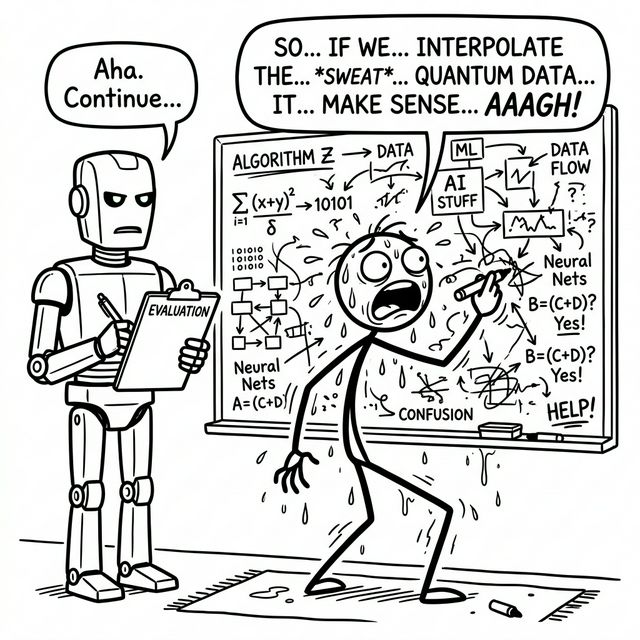
Before optimizing your preparation, understand what you’re being scored on. The evaluation rubric at top companies weights process more than output:
| Dimension | What Interviewers Watch For | Weight |
|---|---|---|
| Problem Understanding | Clarifying questions, restating constraints, identifying edge cases | ~15% |
| Approach & Reasoning | Proposing a brute-force first, reasoning toward optimization, discussing tradeoffs | ~25% |
| Communication | Thinking out loud, explaining decisions, responding to hints | ~25% |
| Code Quality | Clean, readable code with proper naming and logical structure | ~20% |
| Testing & Debugging | Validating with examples, catching bugs, handling edge cases | ~15% |
(Percentages are approximate and vary by company; they’re shown here to illustrate relative emphasis, not an official rubric.)
Notice that correctness is not a separate category. It’s a byproduct of doing all five well. Most interviewers would rather see a candidate who communicates clearly and reaches 80% of the solution than one who silently produces a perfect answer.
This has a direct implication for how you prepare: solving problems is necessary but not sufficient. You also need to practice the performance.
Coding Interview Roadmap: Beginner to Advanced
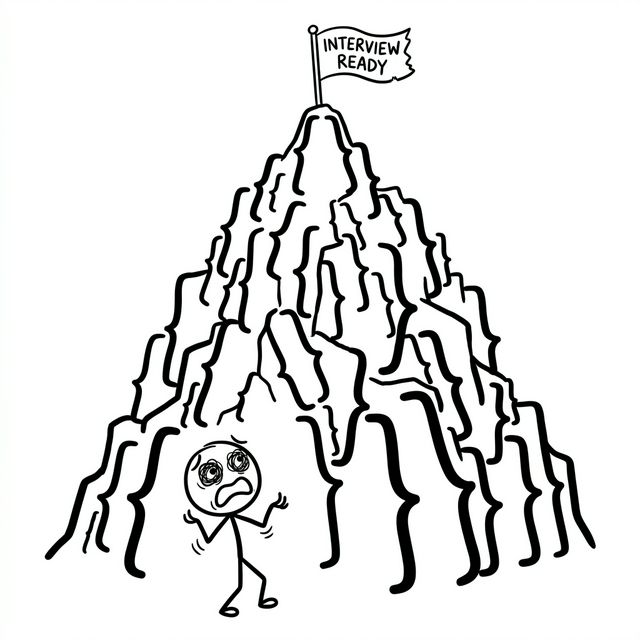
Whether you’re a bootcamp graduate or a senior engineer switching companies, your preparation follows the same trajectory, just at different speeds.
Beginner (New to DSA)
- Learn the core data structures: arrays, hash maps, linked lists, stacks, queues
- Understand the core algorithms: binary search, BFS/DFS, basic sorting
- Solve 50–75 easy problems to build fluency
- Focus on reading and understanding editorials, not speed
Intermediate (Comfortable with Basics)
- Learn to recognize problem patterns (two pointers, sliding window, DP, backtracking)
- Solve 75–150 easy and medium problems across all pattern categories
- Begin timed practice (45 minutes per problem)
- Start mock interviews to practice communication
Advanced (Interview-Ready, Refining)
- Focus on medium problems with pattern combinations and edge cases
- Practice explaining your reasoning out loud under time pressure
- Do mock interviews 2–3× per week
- Review and plug specific weak areas
The key insight: beginners should spend 80% of their time learning, intermediates 50/50 learning and practicing, and advanced candidates 80% practicing. Most people over-index on learning and under-index on simulation.
Coding Interview Study Plan
Not everyone has three months. Here are three structured study plans depending on your timeline. The 2-week plan is for advanced candidates refreshing before an imminent interview. The 1-month plan is for intermediates who want thorough pattern coverage. The 3-month plan is for beginners building DSA skills from scratch: it covers a curated starting set, but beginners should also supplement with additional easy problems from LeetCode’s top interview list to hit the 50–75 easy problem target from the roadmap above. Pick the one that matches your starting point, and follow it daily.
2-Week Coding Interview Prep Plan
Best for: Engineers with solid CS fundamentals who need a focused refresh before upcoming interviews.
Daily commitment: 2–3 hours
| Day | Focus | What to Do |
|---|---|---|
| 1 | Arrays & Hashing | 4 problems: Two Sum, Group Anagrams, Top K Frequent Elements, Contains Duplicate. Start a tracking spreadsheet. |
| 2 | Two Pointers & Sliding Window | 4 problems: Container With Most Water, 3Sum, Longest Substring Without Repeating Characters, [Best Time to Buy and Sell Stock](/blog/walkthroughs/best-time-to-buy-and-sell-stock-interview-wa |
| 4 | Trees (BFS/DFS) | 4 problems: Binary Tree Level Order Traversal, Validate BST, Lowest Common Ancestor, Invert Binary Tree |
| 5 | Graphs & Tries | 4 problems: Number of Islands, Clone Graph, Course Schedule, Implement Trie |
| 6 | DP & Backtracking | 5 problems: Climbing Stairs, Coin Change, Maximum Subarray, Subsets, Combination Sum |
| 7 | Timed practice | Re-solve 3 problems from days 1–6 under 45-minute timer. Talk out loud. |
| 8 | Mock interview #1 | Full 45-minute simulation. Record yourself or use an AI interviewer. |
| 9 | Review + weak patterns | Re-do problems you failed or timed out on. Study the editorial solutions. |
| 10 | Mock interview #2 | Focus on communication: explain every step before writing code. |
| 11 | Mixed timed practice | 3 random medium problems, 45 minutes each, back-to-back. |
| 12 | Mock interview #3 | Simulate a real phone screen: one problem, 45 minutes, full explanation. |
| 13 | Final weak spots | Review your tracking spreadsheet. Re-solve your 3 weakest problems. |
| 14 | Rest + light review | Skim your notes. No new problems. Rest your brain for the real thing. |
Checkpoint: By day 14, you should be able to solve a medium problem in ≤ 30 minutes while explaining your approach out loud.
Use the Grind 75 list sorted by frequency to prioritize the highest-ROI problems.
1-Month Coding Interview Prep Plan
Best for: Candidates with some DSA experience who want thorough, structured preparation.
Daily commitment: 1.5–2 hours
Week 1: Core Data Structures
| Day | Topics | Problems |
|---|---|---|
| Mon | Arrays, Strings | Two Sum, Best Time to Buy and Sell Stock, Valid Anagram |
| Tue | Hash Maps | Group Anagrams, Top K Frequent Elements, Longest Consecutive Sequence |
| Wed | Linked Lists | Reverse Linked List, Merge Two Sorted Lists, Linked List Cycle |
| Thu | Stacks & Monotonic Stack | Valid Parentheses, Min Stack, Daily Temperatures |
| Fri | Review | Re-solve any problems you struggled with. Start your tracking spreadsheet. |
| Sat–Sun | Catch-up or rest | Light review only |
Week 2: Trees, Graphs & Recursion
| Day | Topics | Problems |
|---|---|---|
| Mon | Binary Trees | Invert Binary Tree, Maximum Depth, Binary Tree Level Order Traversal |
| Tue | BSTs | Validate BST, Kth Smallest Element, Lowest Common Ancestor |
| Wed | Graphs (BFS/DFS) | Number of Islands, Pacific Atlantic Water Flow, Course Schedule |
| Thu | Recursion & Backtracking | Subsets, Permutations, Combination Sum |
| Fri | Review | Re-solve failures. Update your spreadsheet with patterns used. |
| Sat–Sun | Catch-up or rest |
Week 3: Advanced Patterns & Timed Practice
| Day | Topics | Problems |
|---|---|---|
| Mon | Sliding Window | Longest Substring Without Repeating Characters, Minimum Window Substring, Sliding Window Maximum |
| Tue | Binary Search | Search in Rotated Sorted Array, Find Minimum in Rotated Sorted Array, Binary Search |
| Wed | Dynamic Programming | Climbing Stairs, Coin Change, Maximum Subarray, Longest Increasing Subsequence |
| Thu | Heaps, Intervals & Tries | Kth Largest Element, Merge Intervals, Meeting Rooms II, Implement Trie |
| Fri | Mock interview #1 | Full simulation. Focus on talking through your approach. |
| Sat–Sun | Review weak areas |
Week 4: Simulation Mode
| Day | Focus |
|---|---|
| Mon | Mock interview #2, focus on time management |
| Tue | 3 random medium problems, back-to-back, timed |
| Wed | Mock interview #3, focus on hint handling |
| Thu | Review your 5 weakest problems from the spreadsheet |
| Fri | Light mock interview, 1 problem, focus on confidence |
| Sat | Rest. Skim notes only. |
| Sun | Interview prep: test environment, prepare desk, sleep early. |
Checkpoint: By week 4, you should be able to identify the correct pattern within 2 minutes of reading a new medium problem.
3-Month Coding Interview Prep Plan
Best for: Career switchers, bootcamp graduates, or anyone building DSA skills from scratch.
Daily commitment: 1–2 hours
Month 1: Build Strong Fundamentals
Goal: Get comfortable solving easy problems and understand core data structures.
| Week | Focus | Problems |
|---|---|---|
| 1 | Arrays, Strings, Hash Maps | Two Sum, Best Time to Buy and Sell Stock, Contains Duplicate, Valid Anagram, Valid Palindrome, Majority Element, Ransom Note, Add Binary |
| 2 | Linked Lists, Stacks, Queues | Reverse Linked List, Merge Two Sorted Lists, Linked List Cycle, Middle of the Linked List, Valid Parentheses, Min Stack, Implement Queue using Stacks |
| 3 | Trees (binary trees, BSTs) | Invert Binary Tree, Maximum Depth of Binary Tree, Diameter of Binary Tree, Balanced Binary Tree, Lowest Common Ancestor of a BST, Validate BST |
| 4 | Graphs, Heaps & Binary Search | Flood Fill, Number of Islands, Binary Search, First Bad Version, K Closest Points to Origin, Meeting Rooms |
Month 1 checkpoint: Can solve most easy problems without hints. Understand core data structure operations and their time complexity. By this point you should have a tracking spreadsheet logging every problem: pattern used, whether you solved it unaided, and what tripped you up.
Resources: NeetCode Roadmap, LeetCode Top Interview 150
Month 2: Pattern Recognition & Speed
Goal: Shift from “learning data structures” to “recognizing problem patterns.”
| Week | Focus | Problems |
|---|---|---|
| 5 | Two Pointers, Sliding Window | 3Sum, Container With Most Water, Longest Substring Without Repeating Characters, Find All Anagrams in a String, Minimum Window Substring, Sort Colors, Trapping Rain Water |
| 6 | Trees & Graphs (BFS/DFS) | Binary Tree Level Order Traversal, Binary Tree Right Side View, Lowest Common Ancestor, Kth Smallest Element in a BST, Course Schedule, Clone Graph, Rotting Oranges, 01 Matrix |
| 7 | Dynamic Programming | Coin Change, Maximum Subarray, Word Break, Unique Paths, Partition Equal Subset Sum, Longest Palindromic Substring |
| 8 | Monotonic Stack, Tries & Backtracking | Min Stack, Largest Rectangle in Histogram, Daily Temperatures, Implement Trie, Combination Sum, Word Search, Letter Combinations of a Phone Number |
Month 2 checkpoint: Can recognize the correct pattern for most medium problems within 2–3 minutes. Solving speed is improving.
Resources: NeetCode 150, LeetCode Patterns
Month 3: Interview Simulation
Goal: Transition from silent problem-solving to interview-ready performance.
| Week | Focus | What to Do |
|---|---|---|
| 9 | Verbal practice + hard problems | Solve 2 problems per day while explaining every step out loud. Add hard problems: LRU Cache, Merge K Sorted Lists, Serialize and Deserialize Binary Tree, Basic Calculator. |
| 10 | Mock interviews | 3 mock interviews this week. Use Intervu, peers, or recorded self-practice. Between mocks, re-solve your weakest problems from months 1–2. |
| 11 | Mixed simulation | Alternate between mock interviews and timed solo problems. Cover gaps: Implement Trie, Search in Rotated Sorted Array, Accounts Merge, Largest Rectangle in Histogram. |
| 12 | Final polish | 2 mock interviews. Re-solve your 5 weakest problems. Light review of notes. Rest the final 2 days. |
Month 3 checkpoint: Can comfortably solve medium problems in 25–30 minutes while communicating clearly. Ready for real interviews.
Coding Interview Checklist
Use this checklist before your first real interview. If you can check every item, you’re ready.
- Can solve medium-difficulty problems in 30 minutes or less
- Can identify the correct pattern within 2 minutes of reading a new problem
- Can explain your approach clearly before writing any code
- Can analyze time and space complexity and explain the tradeoffs
- Have completed at least 3–5 mock interviews with feedback
- Can respond to interviewer hints naturally without freezing
- Can debug your own code by tracing through examples step by step
- Have tested your coding environment (webcam, mic, editor, internet)
- Know your chosen language’s standard library for common interview operations
- Can solve 2–3 problems back-to-back without burning out
If you can check all ten, you’re interview-ready.
The 4-Phase Preparation Framework
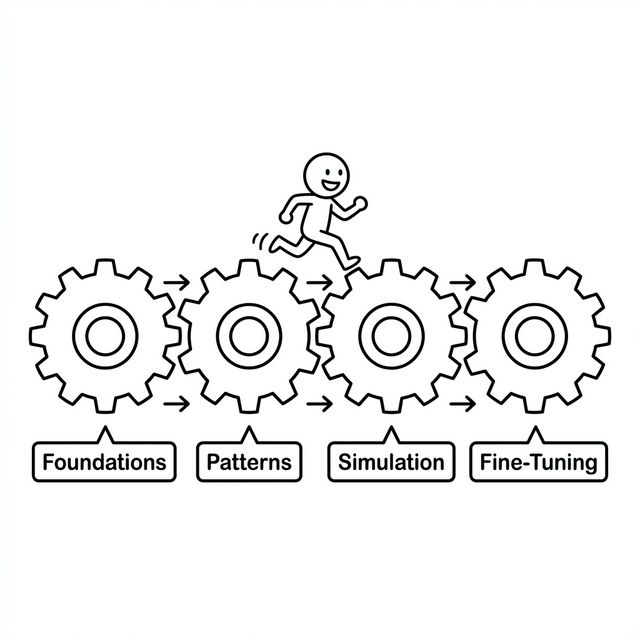
The biggest mistake candidates make is treating preparation as a single activity: “do LeetCode problems.” In reality, interview readiness requires building four distinct skills in sequence. The study plans above implement these phases at different speeds: the 2-week plan compresses all four into 14 days, the 1-month plan gives each phase a full week, and the 3-month plan spends a month on each of the first two.
Phase 1: Build the Foundations
Before you can solve interview problems efficiently, you need fluency with the building blocks.
Core data structures to master:
- Arrays, strings, and hash maps (the bedrock of ~60% of interview questions)
- Linked lists, stacks, and queues
- Trees (binary trees, BSTs, tries)
- Graphs (adjacency lists, BFS, DFS)
- Heaps and priority queues
Core algorithms and techniques:
- Sorting and binary search
- Recursion and backtracking
- Dynamic programming (top-down and bottom-up)
- Sliding window and two pointers
- BFS/DFS for trees and graphs
How to practice this phase:
- Solve 3–5 problems per day, focusing on understanding (not speed).
- After solving, read the editorial and at least one alternative solution.
- After each problem, write down the time/space complexity and why. This trains the analysis muscle interviewers test.
- Keep a spreadsheet: problem name, pattern used, whether you solved it unaided, and what tripped you up. Review failures the next day.
A structured problem list like the Grind 75 is ideal for this phase. It’s ordered by difficulty and covers the essential patterns systematically.
Resources for this phase:
- NeetCode Roadmap: visual map of topics with curated problems for each
- LeetCode Top Interview 150: LeetCode’s own curated list
- Tech Interview Handbook: free guide covering DSA fundamentals and study plans
Phase 2: Pattern Mastery
Once you have the fundamentals, shift from learning data structures to recognizing problem patterns. This is the single biggest unlock for interview performance.
The key patterns that cover ~80% of coding interview questions:
- Two Pointers: sorted arrays, pair sums, container problems
- Sliding Window: substrings, subarrays, streaming data
- BFS/DFS: trees, graphs, islands, shortest paths
- Binary Search: sorted data, search spaces, optimization
- Dynamic Programming: overlapping subproblems, optimal substructure
- Backtracking: permutations, combinations, constraint satisfaction
- Monotonic Stack: next greater element, histogram problems, temperature spans
- Hash Map: frequency counting, two-sum variants, grouping
- Heap / Priority Queue: top-K problems, merging sorted data, scheduling
For each pattern, solve 3–4 problems until you can recognize it within 2 minutes of reading a new problem.
The goal isn’t to memorize solutions. It’s to build intuition. When you see a new problem, you should immediately think “this looks like a sliding window problem” or “I need BFS here.”
This is also where many candidates plateau. If you’ve been grinding LeetCode for months without improving, you’re likely stuck in Phase 1 when you should be in Phase 2: learning patterns rather than solving problems.
Resources for this phase:
- NeetCode 150: problems grouped by pattern with video explanations
- LeetCode Patterns: filterable table of problems organized by pattern
- Coding Interview Patterns: The Complete Guide (2026): all 15 patterns with Python templates, recognition tips, and LeetCode examples
Phase 3: Interview Simulation
Most candidates skip this phase, and it costs them.
The core shift: Move from solving problems silently on your screen to talking through problems out loud under time pressure.
What changes:
- Set a timer. Give yourself exactly 45 minutes per problem. That’s the same constraint you’ll have in the real thing.
- Talk out loud. Explain your thinking as if someone is listening. This feels awkward at first. That’s the point.
- Start with brute force. Say “Here’s a straightforward approach that works but isn’t optimal” before optimizing. Interviewers want to see your reasoning path.
- Do mock interviews. Whether with a friend, a paid service, or an AI interviewer, simulate the real experience. For more on the gap between solving and interviewing, read how to master coding interviews and why realistic mock practice changes everything.
Mock interviews build skills that solo practice can’t:
- How to recover when you’re stuck (instead of freezing)
- How to respond to hints naturally
- How to manage your time so you don’t run out during testing
- How to explain tradeoffs concisely
You can practice any LeetCode problem as a mock interview on Intervu. The AI adapts hints, asks follow-ups, and scores your performance the way a real interviewer would. For AI-specific mock interview practice, intervu.dev’s AI coding interview mode runs a structured session that mirrors the full FAANG interview flow.
Phase 4: Fine-Tuning
In the final stretch before your interviews, shift from learning to consolidation:
- Review your weak patterns. Go back to problems you struggled with and re-solve them.
- Simulate full loops. Do 2–3 problems back-to-back with 5-minute breaks, mimicking a real onsite schedule.
- Optimize your environment. Test your webcam, microphone, and coding setup. Make sure your IDE or editor is configured how you like it.
To see what a full AI-powered mock interview looks like end to end, watch a real-time walkthrough. It breaks down the moments where performance matters most.
Coding Interview Tips That Actually Work
Skip the generic advice. These are the tips that consistently move the needle:
- Start every problem with 2–3 clarifying questions, even if the problem seems obvious. Interviewers expect this and it buys you thinking time.
- Say your brute-force approach out loud first. “I could iterate through every pair in O(n²), but let me see if a hash map brings this to O(n).” This shows reasoning.
- Write code in the order you explained it. Don’t jump between functions. Linear code flow is easier for the interviewer to follow.
- Test with a small example before the interviewer asks. Trace through your code with the given input, line by line. This catches most bugs.
- When stuck, shrink the problem. Ask: “What if the input were only 3 elements?” Smaller inputs often reveal the pattern.
- Use variable names that mean something.
left,right,count,freq_map, noti,j,d. Interviewers read your code too. - Keep it simple. If your approach is clean and correct, don’t over-engineer it chasing a marginal optimization. Interviewers value clarity. A straightforward O(n log n) solution you can explain well often beats a convoluted O(n) one you can’t.
Want to practice these techniques with real-time feedback? Try a mock interview on Intervu →
Common Coding Interview Mistakes

After analyzing thousands of mock interviews, these are the patterns that consistently separate passes from fails.
1. Jumping Straight Into Code
Candidates start typing before they understand the problem. Strong candidates spend the first 5–7 minutes clarifying constraints, working through examples, and discussing their approach.
2. Not Starting With a Simple Solution
Interviewers want to see your reasoning. Start with the simplest approach that works (say “Here’s a straightforward O(n²) approach”) then discuss whether optimization is needed. Jumping straight to a complex optimal solution skips the thinking process interviewers are evaluating.
3. Coding in Silence
This is the single most common failure mode. Interviewers can’t evaluate your thinking if you’re not verbalizing it. Practice narrating: “I’m iterating through the array and using a hash map to track values I’ve seen…“
4. Skipping Edge Cases
When the interviewer gives you [1, 2, 3], strong candidates immediately ask: “What about an empty array? Negative numbers? Duplicates? A single element?” This signals thorough problem analysis.
5. Overcomplicating the Solution
Simpler solutions are better solutions. If your approach requires three nested loops and a custom comparator, step back and ask: “Is there a cleaner way to think about this?“
6. Not Testing Your Code
After writing your solution, walk through it with a concrete example. Trace the variables step by step. This catches bugs before the interviewer does, and demonstrates rigor.
Recognizing these mistakes is easy. Fixing them requires practice under realistic conditions. Simulate a real interview →
How Many LeetCode Problems Are Enough?
You need 75–100 problems with deep pattern understanding. This beats grinding 500 problems with shallow memorization every time.
Here’s how to think about it:
The breakdown:
| Level | Problem Count | Focus |
|---|---|---|
| Minimum viable | 50 easy + 25 medium | Core patterns only |
| Solid foundation | 75 problems (Grind 75) | All major patterns, properly tracked |
| Strong preparation | 100–150 problems | Patterns + speed + tricky mediums |
| Diminishing returns | 200+ | Only if weak in specific areas |
The real metric isn’t problem count. It’s pattern recognition speed. When you can read a new medium problem and identify the right approach within 2 minutes, you’ve done enough.
Focus your time on the Grind 75 for maximum coverage with minimum problems. If you have more time, expand to the full Grind 169 with our step-by-step practice guide.
Mock Interviews vs Solo Practice
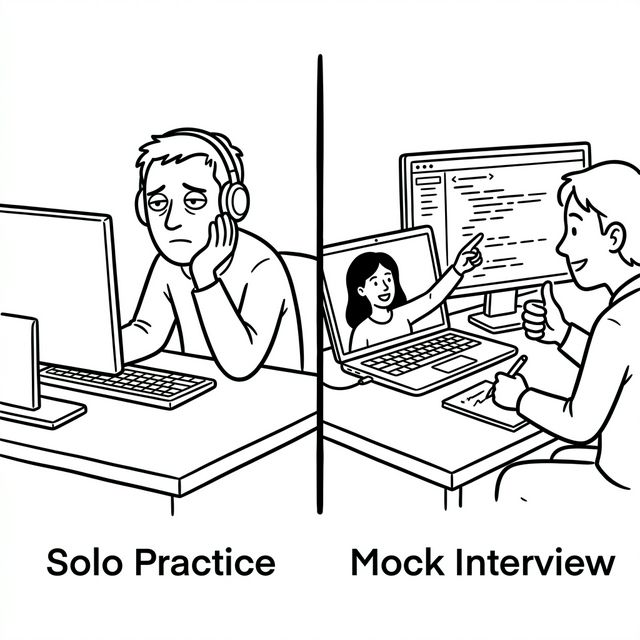
Athletes scrimmage before games. Pilots use flight simulators. Performance under pressure is a different skill than practice without it.
| Factor | Solo LeetCode | Mock Interviews |
|---|---|---|
| Builds pattern recognition | ✅ | ✅ |
| Practices communication | ❌ | ✅ |
| Simulates time pressure | Partially | ✅ |
| Provides external feedback | ❌ | ✅ |
| Practices hint handling | ❌ | ✅ |
| Available anytime | ✅ | Depends on format |
The verdict: You need both. Use solo practice for Phase 1–2 (foundations and patterns), then switch to mock interviews for Phase 3–4 (simulation and fine-tuning).
Your options:
- Peer practice: Free, but inconsistent quality and scheduling challenges
- Professional coaching: High quality, but expensive ($100–300 per session)
- AI-powered platforms: Available 24/7, consistent quality, instant feedback
At Intervu, the AI interviewer runs realistic mock coding interviews with voice interaction, a live code editor, and detailed scoring. You can practice any problem from the Grind 75 list or import any LeetCode problem directly. Curious how it works? Read how the AI interviewer was built.
Language-Specific Tips
Your choice of language matters less than fluency in it. But knowing your language’s standard library well can save critical minutes in a 45-minute round. Here’s what to focus on for each:
Python
Python is the most popular interview language for a reason: concise syntax means less time typing and more time thinking. For a quick recap of essential built-ins, check our Python Coding Interview Cheat Sheet. For a complete reference of templates and patterns for every data structure, see our Python Data Structures Companion Guide.
Must-know standard library:
collections.defaultdictandcollections.Counter: eliminates boilerplate for frequency counting and groupingheapq: Python only has a min-heap; for a max-heap, negate values (heapq.heappush(h, -val))bisect.bisect_left/bisect.insort: binary search and sorted insertion in one lineitertools.combinations/itertools.permutations: useful for brute-force approaches before optimizingsorted()withkey=lambda: custom sorting is extremely common in interviews
Common pitfalls:
- Mutable default arguments (
def f(x=[])): a classic Python gotcha - Integer division:
//truncates toward negative infinity, not toward zero. Useint(a/b)if you need C-style truncation - List slicing creates copies:
nums[:]is O(n), not O(1)
JavaScript
A strong choice if you’re a frontend engineer, but be aware of the quirks that can bite you under pressure. For a complete guide to the language features and idioms you actually need, check our JavaScript Coding Interview Cheat Sheet.
Must-know features:
MapandSet: use these instead of plain objects for hash-based problems.Mappreserves insertion order and handles any key typeArray.sort(): sorts lexicographically by default! Always pass a comparator:arr.sort((a, b) => a - b)- Spread and destructuring:
const [first, ...rest] = arris clean for recursive patterns String.prototype.charCodeAt(): needed for character-to-index math (e.g.,c.charCodeAt(0) - 'a'.charCodeAt(0))
Common pitfalls:
- No built-in heap or priority queue: you’ll need to implement one or use a sorted approach
===vs==: always use strict equality in interviews to avoid type coercion surprisesArray.splice()is O(n): avoid it inside loops when performance matters
Java
Verbose, but the type system catches bugs at compile time, which is valuable when you can’t run code. For a complete guide to the Collections framework and idioms you actually need, check our Java Coding Interview Cheat Sheet.
Must-know classes:
HashMap/HashSet: the workhorses. Know.getOrDefault(),.putIfAbsent(), and.computeIfAbsent()to write cleaner codePriorityQueue: min-heap by default. For max-heap:new PriorityQueue<>(Collections.reverseOrder())TreeMap/TreeSet: sorted collections with O(log n) operations..floorKey(),.ceilingKey()are powerful for range queriesDeque(asArrayDeque): use for both stacks and queues instead ofStackorLinkedListStringBuilder: always use this for string concatenation in loops;String +=is O(n²)
Common pitfalls:
- Integer comparison: use
.equals()not==forIntegerobjects (values > 127 are not cached) - Array initialization:
int[][] dp = new int[m][n]. Java initializes to 0, but confirm with your interviewer - Generics don’t work with primitives; use
Integer, notint, in collections
C++
The fastest option and favored in competitive programming, but harder to debug under interview pressure. For a complete guide to the STL containers and algorithms you actually need, check our C++ Coding Interview Cheat Sheet.
Must-know STL:
unordered_map/unordered_set: O(1) average hash lookupspriority_queue: max-heap by default. For min-heap:priority_queue<int, vector<int>, greater<int>>sort()with custom comparators:sort(v.begin(), v.end(), [](auto& a, auto& b) { ... })lower_bound/upper_bound: binary search on sorted containerspair<int,int>and structured bindings (auto [a, b] = p): clean for graph and coordinate problems
Common pitfalls:
- Iterator invalidation: modifying a container while iterating over it causes undefined behavior
- Off-by-one errors with
.end(): it points past the last element, not to it - Memory: prefer
vectorover raw arrays; usereserve()if you know the size upfront to avoid reallocations
Go (Golang)
Simplicity is Go’s superpower, but its minimal standard library means you’ll need to know exactly what’s available and when to roll your own. For a complete guide to Go idioms, built-ins, and common workarounds you actually need, check our Go Coding Interview Cheat Sheet.
Must-know features:
- Slices: fast but created as references, not copies (
shallow := original); usecopy()orappend([]int{}, s...)for true copies - Maps: Go has no built-in set, so
map[int]boolormap[int]struct{}are your go-to replacements sort.Slice(): essential because you must provide comparator functions for custom structs or descending sorts
Common pitfalls:
- No built-in min/max for integers (prior to Go 1.21), requiring you to write your own
minInt/maxInthelpers - No built-in priority queue: you must write the
container/heapinterface boilerplate yourself (practice this!) - Bitwise NOT is
^x, not~x; clearing a bit uses the “AND NOT” operatorx &^= mask
Which Language Should You Choose?
The best language is the one you can write clean, bug-free code in without thinking about syntax. If you’re equally comfortable in multiple languages, Python is the safest choice. It lets you express ideas in the fewest lines, giving you more time to think and communicate.
The Day Before Your Interview
The final 24 hours matter more than most candidates realize.
Do:
- Review your 3–5 weakest problem patterns, but don’t learn anything new
- Re-solve 2–3 medium problems you’ve already cracked, just for confidence
- Test your environment: webcam, microphone, editor, internet connection
- Prepare your desk: water, notepad for scratch work, quiet room
- Get 7–8 hours of sleep. Cognitive performance drops sharply with sleep debt
Don’t:
- Cram new topics: it creates anxiety without building real skill
- Attempt new or unfamiliar problems: a frustrating session the night before hurts your confidence
- Stay up late reading solutions: diminishing returns after 9 PM
- Skip meals: your brain runs on glucose
The goal is to arrive calm, rested, and confident in the skills you’ve already built.
What to Expect on Interview Day
A typical FAANG interview loop looks like this:
Phone Screen (45 min)
    → 1–2 coding problems, easy to medium difficulty
    → Pass: invited to virtual onsite

Virtual Onsite (4–5 rounds, 45 min each)
    → 2–3 coding rounds
    → 1 system design round (mid/senior)
    → 1 behavioral round
Time management within a 45-minute round (for a single problem; if given two, aim for ~20 minutes each):
| Phase | Time | What to Do |
|---|---|---|
| Understand | 0–5 min | Read the problem, ask clarifying questions, state assumptions |
| Plan | 5–10 min | Discuss a simple approach first, then propose your optimized approach |
| Code | 10–30 min | Write clean, readable code |
| Test | 30–40 min | Trace through examples, fix bugs |
| Discuss | 40–45 min | Complexity analysis, follow-up questions |
Each FAANG company runs this loop differently: Google uses Google Docs with follow-up escalation, Meta gives you two problems in 35 minutes, and Amazon includes a debugging OA. For company-by-company format details and targeted preparation strategies, see our FAANG coding interview guide.
When you get stuck:
- Say so. “I’m not immediately seeing the optimal approach. Let me think about what data structure would help here.”
- Ask for a hint. Interviewers expect this. Using hints well is a positive signal.
- Work through a concrete example. Often, tracing through the input manually reveals the pattern.
What to Do If You Don’t Pass
Most engineers who eventually get offers have at least one rejection first. Failing an interview loop is not a signal that you’re not good enough. It usually means one of three things: your fundamentals need more depth, your communication under pressure needs more reps, or you happened to get a problem type you hadn’t practiced.
Step 1: Debrief while it’s fresh. Write down every problem you were asked. Note which ones you got stuck on, which ones you solved but communicated poorly, and which ones you handled well. This is the most valuable signal you’ll get.
Step 2: Identify the root cause. Most failures fall into one of these categories:
| Root Cause | Signs | Fix |
|---|---|---|
| Weak fundamentals | Couldn’t recall the right data structure or algorithm | Go back to Phase 1. Solve 20–30 more easy problems in the gap area. |
| Pattern blindness | Recognized a hard problem but picked the wrong approach | Focus on Phase 2 pattern drills. For each pattern, solve 5+ problems. |
| Communication breakdown | Solved it but got poor feedback | Do 5+ mock interviews before re-applying. Record yourself. |
| Time pressure | Froze or ran out of time consistently | Practice with a strict 35-minute timer instead of 45. |
| Specific topic gap | Consistently failed one topic (e.g. DP, graphs) | Spend a full week on that topic before re-applying. |
Step 3: Respect the re-application window. Most companies enforce a 3–6 month waiting period before you can re-interview. Use that time intentionally. Candidates who return after structured re-preparation pass at significantly higher rates than those who re-apply immediately.
Step 4: Keep your qualitative notes. Log the specific questions you were asked (in general terms, not verbatim). Over multiple interview loops, you’ll start to see patterns in what companies emphasize, and you can optimize your preparation accordingly.
The engineers who eventually land offers are rarely the ones who aced their first loop. They’re the ones who treated each rejection as a targeted feedback signal and came back with a sharper plan.
Recommended Resources
Here’s a curated list of the best free and paid resources, organized by what they’re best for:
| Category | Resource | Why It’s Useful |
|---|---|---|
| Problem Lists | Grind 75 | Optimized 75-problem list, ordered by ROI |
| Problem Lists | Blind 75 | The original curated list that started the trend |
| Pattern Learning | NeetCode | Video explanations + roadmap organized by pattern |
| Pattern Learning | LeetCode Patterns | Filterable table mapping problems to patterns |
| Study Guide | Tech Interview Handbook | Free, comprehensive guide covering DSA fundamentals |
| Mock Interviews | Intervu.dev | AI-powered mock interviews with voice, code editor, and scoring |
| Mock Interviews | Pramp | Free peer-to-peer mock interviews |
Frequently Asked Questions
How do you prepare for a coding interview?
Follow a structured approach: (1) build DSA fundamentals, (2) learn problem-solving patterns, (3) practice under timed interview conditions with mock interviews, and (4) review weak areas. Most candidates need 4–8 weeks of consistent daily practice.
How long does it take to prepare for a coding interview?
It depends on your starting point. With a CS background and some algorithm familiarity, 4–6 weeks of focused preparation is typical. Starting from scratch, plan for 2–3 months. The key is consistency. 1–2 hours daily is more effective than weekend cramming sessions.
How many LeetCode problems should I solve?
75–100 problems with deep understanding of patterns is more effective than grinding 500 problems. Focus on the Grind 75 list for maximum coverage with minimal problems. The right metric is pattern recognition speed, not problem count.
What is the best way to practice coding interviews?
Combine pattern-based problem solving with mock interviews. Solo practice builds your algorithm toolkit. Mock interviews build the communication, time management, and pressure-handling skills that determine your actual interview performance.
What are the best coding interview tips?
Start every problem with clarifying questions, propose a brute-force approach before optimizing, think out loud throughout, test your code with examples before the interviewer asks, and use meaningful variable names. These five habits cover the majority of what separates strong candidates from weak ones.
What are the most common coding interview mistakes?
The top mistakes are: jumping into code without understanding the problem, coding in silence, skipping edge cases, over-engineering the solution, and not testing your code with examples.
Are mock interviews really necessary?
Yes. Solving problems and performing in an interview are fundamentally different skills. Communication, time management, and composure under pressure can only be developed through simulation. Even 3–5 mock interviews will significantly improve your performance.
Should I use Python or Java for coding interviews?
Use the language you’re most comfortable writing bug-free code in. Python is the most popular choice due to its concise syntax and built-in data structures. If you choose Python, our Python Data Structures Companion has ready-to-use code templates for every structure covered in this guide. Java and C++ are equally valid. Avoid learning a new language just for interviews.
What if I get stuck during the interview?
Getting stuck is normal and expected. Verbalize your thought process: “I’m considering a hash map approach but I’m not sure how to handle duplicates.” Ask for a hint: interviewers provide them intentionally, and using them well is a positive signal. Try working through a small concrete example to find the pattern.
Browse All Interview Walkthroughs
Every walkthrough below shows how a problem unfolds in a real coding interview: the clarifying questions, the brute-force starting point, the optimization path, and the interviewer dialogue that separates passes from fails. Browse the full collection →
Easy: Two Sum · Valid Parentheses · Merge Two Sorted Lists · Best Time to Buy and Sell Stock · Linked List Cycle · Invert Binary Tree · Binary Search · Climbing Stairs · Reverse Linked List · Maximum Depth of Binary Tree · Contains Duplicate · Valid Anagram · Valid Palindrome · Majority Element · Add Binary · Diameter of Binary Tree · Lowest Common Ancestor of a BST · Balanced Binary Tree · First Bad Version · Middle of the Linked List · Flood Fill · Implement Queue using Stacks · Ransom Note · Longest Palindrome · Meeting Rooms · Min Stack · Maximum Subarray
Medium: 3Sum · Longest Substring Without Repeating Characters · Coin Change · Number of Islands · Product of Array Except Self · Container With Most Water · Merge Intervals · Course Schedule · Validate Binary Search Tree · Search in Rotated Sorted Array · Combination Sum · Permutations · Subsets · Lowest Common Ancestor · Word Break · Longest Palindromic Substring · Binary Tree Level Order Traversal · Implement Trie · LRU Cache · Clone Graph · Rotting Oranges · 01 Matrix · Accounts Merge · Binary Tree Right Side View · Partition Equal Subset Sum · Evaluate Reverse Polish Notation · Kth Smallest Element in a BST · Insert Interval · Sort Colors · Word Search · Spiral Matrix · Unique Paths · K Closest Points to Origin · Find All Anagrams in a String · Letter Combinations of a Phone Number · Time Based Key-Value Store · String to Integer (atoi) · Task Scheduler · Minimum Height Trees · Construct Binary Tree from Preorder and Inorder
Hard: Trapping Rain Water · Merge K Sorted Lists · Minimum Window Substring · Basic Calculator · Serialize and Deserialize Binary Tree · Find Median from Data Stream · Word Ladder · Largest Rectangle in Histogram · Maximum Profit in Job Scheduling
Start Practicing Like It’s the Real Interview
Coding interview preparation isn’t about memorizing solutions. It’s about building a practice habit that develops the skills interviewers actually evaluate: structured thinking, clear communication, and calm execution under pressure.
Follow the framework:
- Foundations: Master the core data structures and algorithms
- Pattern Mastery: Recognize problem types within 2 minutes
- Interview Simulation: Practice talking, timing, and handling pressure
- Fine-Tuning: Consolidate, rest, and arrive confident
The candidates who get offers aren’t the ones who solved the most problems. They’re the ones who practiced like the real interview.
Ready to start? Try a mock coding interview now →