Sort Colors — Coding Interview Walkthrough
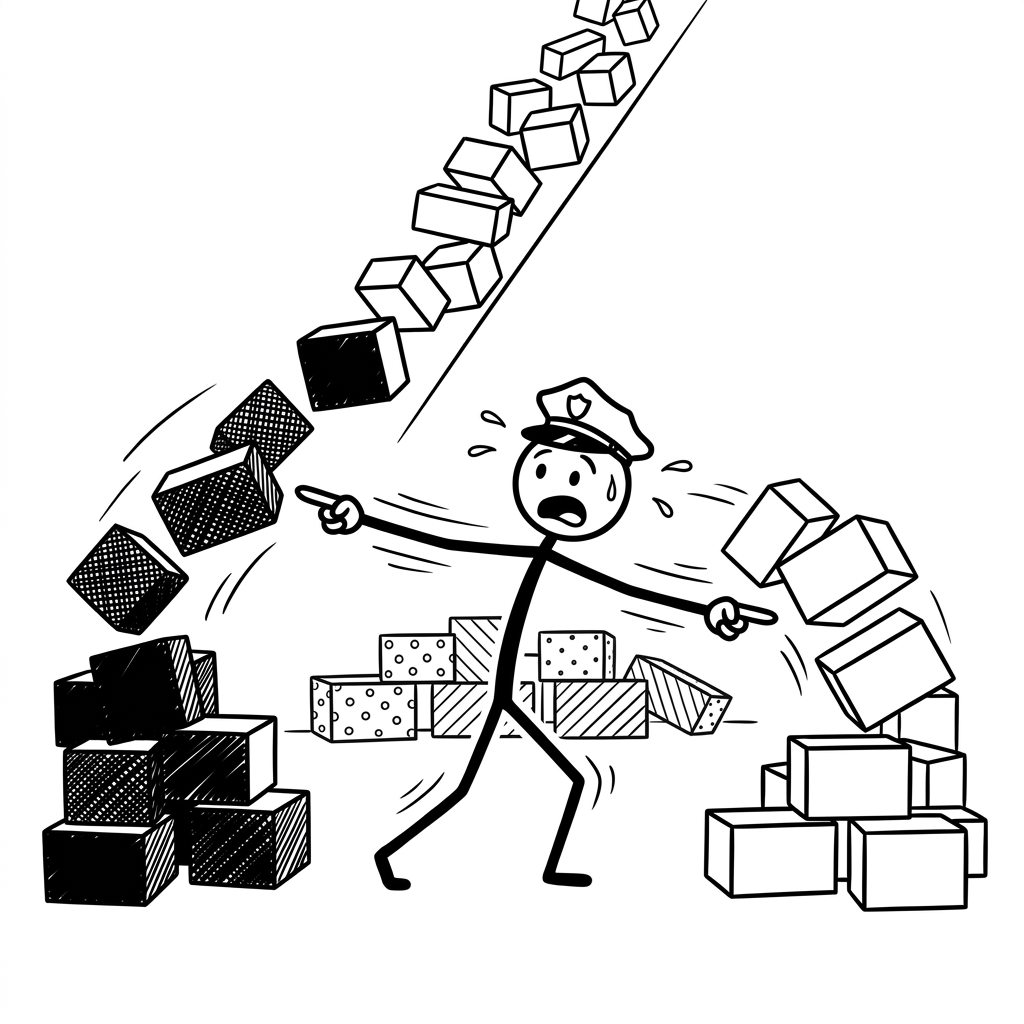
The core approach: Sort Colors is solved with the Dutch National Flag algorithm in O(n) time and O(1) space. Maintain three pointers — low, mid, and high. Swap elements to ensure 0s accumulate before low, 1s between low and mid, and 2s after high. Each swap advances at least one pointer, guaranteeing a single-pass sort without extra space.
You’re in a coding interview. The interviewer says: “Sort an array of 0s, 1s, and 2s in place without using a library sort.” The two-pass counting sort is obvious — but the one everyone remembers is the Dutch National Flag algorithm: a single-pass, O(1) space solution using three pointers.
Already know how to solve Sort Colors? Try a Sort Colors mock interview on Intervu →
The Problem
Given an array nums with objects colored red (0), white (1), or blue (2), sort them in place so same-colored objects are adjacent, in order 0, 1, 2.
Example
Input: nums = [2, 0, 2, 1, 1, 0]
Output: [0, 0, 1, 1, 2, 2]
What Interviewers Are Actually Testing
| Skill | What Interviewers Observe |
|---|---|
| Dutch National Flag | Do you know the three-pointer algorithm? |
| Pointer invariants | Can you state what each pointer represents? |
| Loop termination | Do you use mid <= high (not < high)? |
| One-pass vs. two-pass | Can you optimize from counting sort to DNF? |
Step 1: The Key Insight
Three pointers maintain three regions: low marks the 0-boundary, high marks the 2-boundary, mid scans. When nums[mid] is 0, swap to low and advance both. When 2, swap to high and retreat high only (don’t advance mid — the swapped value is unseen). When 1, advance mid.
![Sorted array [0,0,1,1,2,2] with three pointers: lo (pink) at red boundary, mid (teal) scanning, hi (blue) at blue boundary.](/blog/images/sort-colors-viz.png)
Python Implementation
def sortColors(nums: list[int]) -> None:
    low, mid, high = 0, 0, len(nums) - 1

    while mid <= high:
        if nums[mid] == 0:
            nums[low], nums[mid] = nums[mid], nums[low]
            low += 1
            mid += 1
        elif nums[mid] == 1:
            mid += 1
        else:
            nums[mid], nums[high] = nums[high], nums[mid]
            high -= 1
            # Don't increment mid — swapped value needs examination
Time & Space Complexity
| Aspect | Complexity |
|---|---|
| Time | O(n) — single pass |
| Space | O(1) — in place |
Common Interview Mistakes
- Incrementing
midafter swapping withhigh. The value fromhighis unseen — don’t skip it. - Using
mid < highinstead ofmid <= high. When equal,nums[mid]is still unsorted. - Proposing a general sort. Use the constrained value set — that’s the point.
What a Strong Candidate Sounds Like
“I’ll use the Dutch National Flag algorithm. Three pointers:
low,mid,high. Everything left oflowis 0, betweenlowandmidis 1, right ofhighis 2. When I see a 0, swap to left and advance both. When 2, swap to right and retreathighonly. One pass, O(1) space.”
Related Problems to Practice
- Two Sum — Array manipulation fundamentals.
- Container With Most Water — Two-pointer pattern.
- 3Sum — Multi-pointer array traversal.
Frequently Asked Questions
How do you sort an array seamlessly in a single iteration pass?
You employ the Dutch National Flag algorithm utilizing three distinct pointers. A low pointer acts as a gatekeeper for zeroes pushing them forward, a high pointer safely sequesters two’s pushing them backwards, and a mid pointer acts as the scanning agent navigating unclassified elements.
What remains the primary advantage of the Dutch National Flag approach?
Normal sorting functions inherently demand O(N log N) runtime overhead. But by actively swapping exactly three known numerical values cleanly via opposing pointer bounds, this algorithm achieves perfectly sorted array states dynamically in exactly O(N) linear time and O(1) in-place space.
Practice This in a Mock Interview
Start a mock interview for Sort Colors on Intervu.
Further reading:
- How to Prepare for a Coding Interview in 2026, the complete roadmap
- Why LeetCode alone isn’t enough, and what to practice instead
- Practice any LeetCode problem as a live mock interview
- The Grind 75 Pathway, a structured study plan with AI practice links
- Browse all walkthroughs on GitHub, condensed solutions with code