Letter Combinations of a Phone Number — Coding Interview Walkthrough
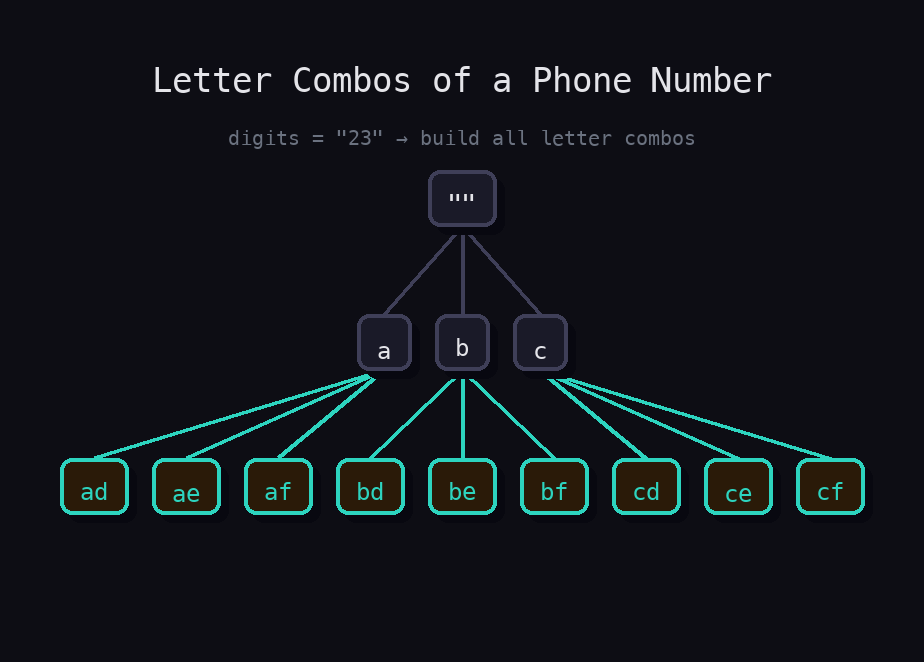
The core approach: Letter Combinations of a Phone Number is solved with backtracking in O(4^n × n) time and O(n) space. Map each digit to its letters. Recursively build combinations character by character, appending a letter for the current digit and recursing on the next. When the combination length equals the input length, add it to the result.
You’re in a coding interview. The interviewer says: “Given a string of digits 2–9, return all possible letter combinations from a phone keypad.” You’re building the Cartesian product of letter-sets — one per digit. Backtracking models this naturally.
Already know how to solve Letter Combinations Of A Phone Number? Try a Letter Combinations Of A Phone Number mock interview on Intervu →
The Problem
Given a string containing digits from 2-9, return all possible letter combinations. Mapping: 2→abc, 3→def, 4→ghi, 5→jkl, 6→mno, 7→pqrs, 8→tuv, 9→wxyz.
Example
Input: digits = "23"
Output: ["ad","ae","af","bd","be","bf","cd","ce","cf"]
What Interviewers Are Actually Testing
| Skill | What Interviewers Observe |
|---|---|
| Backtracking structure | Do you use “build, recurse, undo” cleanly? |
| Base case | Do you add to results when path length equals digit count? |
| Empty input | Do you return [] for empty digits? |
Step 1: The Key Insight
The problem is the Cartesian product of multiple letter-sets. At depth i, pick each letter for digits[i], recurse to i+1, and undo.
Python Implementation
def letterCombinations(digits: str) -> list[str]:
    if not digits:
        return []

    phone_map = {
        '2': 'abc', '3': 'def', '4': 'ghi', '5': 'jkl',
        '6': 'mno', '7': 'pqrs', '8': 'tuv', '9': 'wxyz'
    }

    results = []
    current = []

    def backtrack(index: int) -> None:
        if index == len(digits):
            results.append(''.join(current))
            return
        for letter in phone_map[digits[index]]:
            current.append(letter)
            backtrack(index + 1)
            current.pop()

    backtrack(0)
    return results
Time & Space Complexity
| Aspect | Complexity |
|---|---|
| Time | O(4ⁿ × n) — some keys have 4 letters |
| Space | O(n) — recursion stack |
Common Interview Mistakes
- Not handling empty input. Return
[]fordigits = "". - String concatenation instead of list. Can’t efficiently undo
+=. Use list +pop(). - Forgetting the undo step.
current.pop()after recursion is essential.
What a Strong Candidate Sounds Like
“Backtracking over a decision tree. At each depth I choose a letter for the current digit. I maintain a path list, recurse, and pop after each call. Time is O(4ⁿ × n).”
Related Problems to Practice
- Subsets — Same backtracking structure.
- Combination Sum — Backtracking with target constraint.
- Permutations — Backtracking for ordered arrangements.
Frequently Asked Questions
What algorithm generates all possible letter combinations of a phone number?
Backtracking naturally models the combination process. By mapping the phone digits to letters, you recursively iterate through each letter choice for a given digit, passing the constructed string deeper into the call stack until hitting the length limit.
What is the time complexity to calculate the phone number combinations?
The absolute worst-case time complexity is O(4^N * N), originating from the digits 7 and 9 which contain 4 mapped letters each. Generating every branching path scales exponentially, and formatting those path strings takes linear overhead.
Practice This in a Mock Interview
Start a mock interview for Letter Combinations on Intervu.
Further reading:
- How to Prepare for a Coding Interview in 2026, the complete roadmap
- Why LeetCode alone isn’t enough, and what to practice instead
- Practice any LeetCode problem as a live mock interview
- The Grind 75 Pathway, a structured study plan with AI practice links
- Browse all walkthroughs on GitHub, condensed solutions with code