Spiral Matrix — Coding Interview Walkthrough
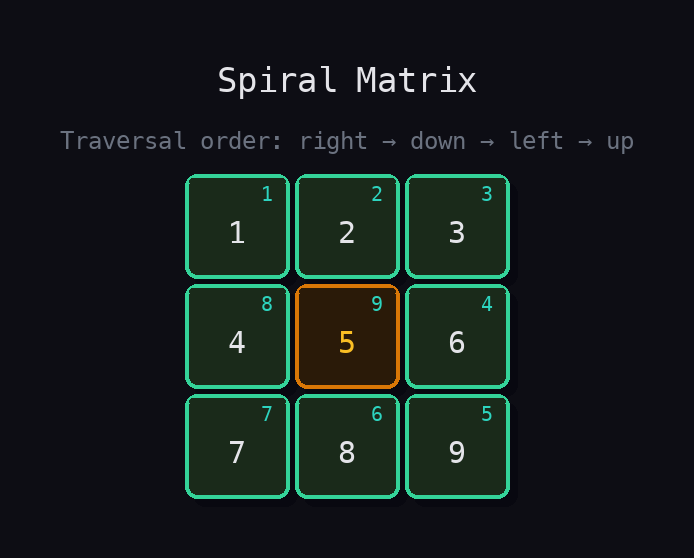
The core approach: Spiral Matrix is solved by shrinking four boundaries in O(m×n) time and O(1) extra space. Maintain top, bottom, left, and right boundaries. Traverse each boundary in order — right across the top, down the right, left across the bottom, up the left — then tighten the corresponding boundary inward. Repeat until all elements are collected.
You’re in a coding interview. The interviewer says: “Traverse an m × n matrix in spiral order.” There’s no clever algorithm — just careful boundary management. You shrink your traversal window after each pass (right, down, left, up) and stop when the boundaries cross.
Already know how to solve Spiral Matrix? Try a Spiral Matrix mock interview on Intervu →
The Problem
Given an m x n matrix, return all elements in spiral order.
Example
Input: matrix = [[1,2,3],[4,5,6],[7,8,9]]
Output: [1, 2, 3, 6, 9, 8, 7, 4, 5]
What Interviewers Are Actually Testing
| Skill | What Interviewers Observe |
|---|---|
| Boundary tracking | Do you track top, bottom, left, right and shrink them? |
| Loop termination | Do you check boundaries before left/up passes? |
| Non-square matrix | Does your solution handle m ≠ n, single row, single column? |
Step 1: The Key Insight
Maintain four boundaries: top, bottom, left, right. After traversing each edge, shrink the corresponding boundary inward. Check boundaries before the left and up passes to handle single-row or single-column remainders.
Python Implementation
def spiralOrder(matrix: list[list[int]]) -> list[int]:
    result = []
    top, bottom = 0, len(matrix) - 1
    left, right = 0, len(matrix[0]) - 1

    while top <= bottom and left <= right:
        for c in range(left, right + 1):
            result.append(matrix[top][c])
        top += 1

        for r in range(top, bottom + 1):
            result.append(matrix[r][right])
        right -= 1

        if top <= bottom:
            for c in range(right, left - 1, -1):
                result.append(matrix[bottom][c])
            bottom -= 1

        if left <= right:
            for r in range(bottom, top - 1, -1):
                result.append(matrix[r][left])
            left += 1

    return result
Time & Space Complexity
| Aspect | Complexity |
|---|---|
| Time | O(m × n) — every cell visited once |
| Space | O(1) extra (not counting output) |
Common Interview Mistakes
- Not checking boundaries before left/up passes. If only one row remains after the right pass, the left pass duplicates cells.
- Off-by-one in ranges.
range(left, right + 1)for right,range(right, left - 1, -1)for left. - Hardcoding for square matrices. Must handle m ≠ n. Test with 1×4 and 4×1.
What a Strong Candidate Sounds Like
“Four boundary variables: top, bottom, left, right. Each iteration traverses one layer: right, down, left, up. After each pass I shrink the boundary. I guard left/up passes with boundary checks for single-row/column cases. O(m×n) time, O(1) extra space.”
Related Problems to Practice
- Product of Array Except Self — Array traversal discipline.
- Binary Tree Level Order Traversal — Layer-by-layer traversal.
Frequently Asked Questions
What logic naturally navigates a Spiral Matrix traversal cleanly?
Simply maintaining four dynamic boundary variables: Top, Bottom, Left, and Right cleanly fences the operation inwards. By traversing boundaries sequentially (rightwards, downwards, leftwards, upwards) and squeezing the corresponding boundary constraints inwards dynamically after each pass, the shrinking spiral solves itself smoothly.
Why must you continuously check boundary conditions within the spiral loop?
Matrices aren’t exclusively uniform squares; rectangular inputs squeeze violently in asymmetric ways. Even if the broader loop survives conditionally, verifying left <= right and top <= bottom immediately before reversed inner-loop traversals cleanly prevents redundant overlapping duplicate reads.
Practice This in a Mock Interview
Start a mock interview for Spiral Matrix on Intervu.
Further reading:
- How to Prepare for a Coding Interview in 2026, the complete roadmap
- Why LeetCode alone isn’t enough, and what to practice instead
- Practice any LeetCode problem as a live mock interview
- The Grind 75 Pathway, a structured study plan with AI practice links
- Browse all walkthroughs on GitHub, condensed solutions with code