Binary Tree Level Order Traversal — Coding Interview Walkthrough
You’re in a coding interview. The interviewer says: “Given the root of a binary tree, return its level order traversal.” You know it’s BFS. You know you need a queue. But the moment you start coding, they’re watching how you separate levels, whether you reach for deque or list.pop(0), and whether you can extend your solution to zigzag traversal when they ask the follow-up.
This walkthrough breaks down exactly how to structure your approach, what to say out loud, and where candidates lose points even when they get the right answer.
The Problem
Given the root of a binary tree, return the node values grouped by level, from top to bottom. Each level is its own list.
Example
Input
      3
     / \
    9  20
   /  /  \
  4  15   7
root = [3, 9, 20, 4, null, 15, 7]
Output
[[3], [9, 20], [4, 15, 7]]
At depth 0, we have just 3. At depth 1, 9 and 20. At depth 2, 4, 15, and 7. (LeetCode #102)
Already comfortable with the solution? Practice it in a mock interview →
What Interviewers Are Actually Testing
This problem is rarely about whether you know BFS. It’s about whether you can think clearly about traversal order and layer separation.
| Skill | What Interviewers Observe |
|---|---|
| BFS intuition | Do you reach for a queue without prompting? |
| Layer tracking | Can you separate nodes by depth within a single BFS pass? |
| Edge case awareness | Do you handle null root and single-node trees? |
| Communication | Do you explain your approach before coding? |
| Code clarity | Are your variable names readable? Is the loop logic clean? |
| Follow-up adaptability | Can you extend to zigzag, right-side view, or vertical order? |
Step 1: Clarifying Questions
Before writing a single line of code, a strong candidate asks the right questions:
-
“Can the tree be empty (null root)?” The most important edge case. If you don’t ask, you might crash on
root.valbefore you even start. -
“Should I return nested lists or a flat list?” The LeetCode version returns
List[List[int]], but interviewers sometimes phrase this loosely. Confirming the output shape prevents you from building the wrong structure. -
“Are node values unique?” Doesn’t affect the algorithm here, but asking shows you’re thinking about edge cases in the data, not just the structure.
-
“Is there a constraint on tree size or depth?” For very deep trees (10^5+ nodes), stack-based DFS might cause recursion limits.
-
“Are there follow-up requirements, like alternating level direction?” This signals awareness of variants (zigzag traversal) and helps you design extensible code.
Step 2: A First (Non-Optimal) Idea
The intuitive first attempt is often a recursive DFS approach with a depth parameter:
def levelOrder(root):
    result = [, "medium"]
    def dfs(node, depth):
        if not node:
            return
        if depth == len(result):
            result.append([])
        result[depth].append(node.val)
        dfs(node.left, depth + 1)
        dfs(node.right, depth + 1)
    dfs(root, 0)
    return result
This actually works and is O(n) time and space, so why isn’t it always the best choice?
DFS visits nodes in pre-order (root, left, right), which means you’re not processing nodes level-by-level. You’re inferring level membership from a depth counter. This works for this specific problem, but it breaks down when the order of processing within a level matters. It also relies on recursion, which can hit Python’s default recursion limit (~1000) for very deep trees.
More importantly: reaching for DFS on a “level order” problem signals to the interviewer that you’re not thinking in terms of the natural data structure (a queue).
Step 3: The Key Insight
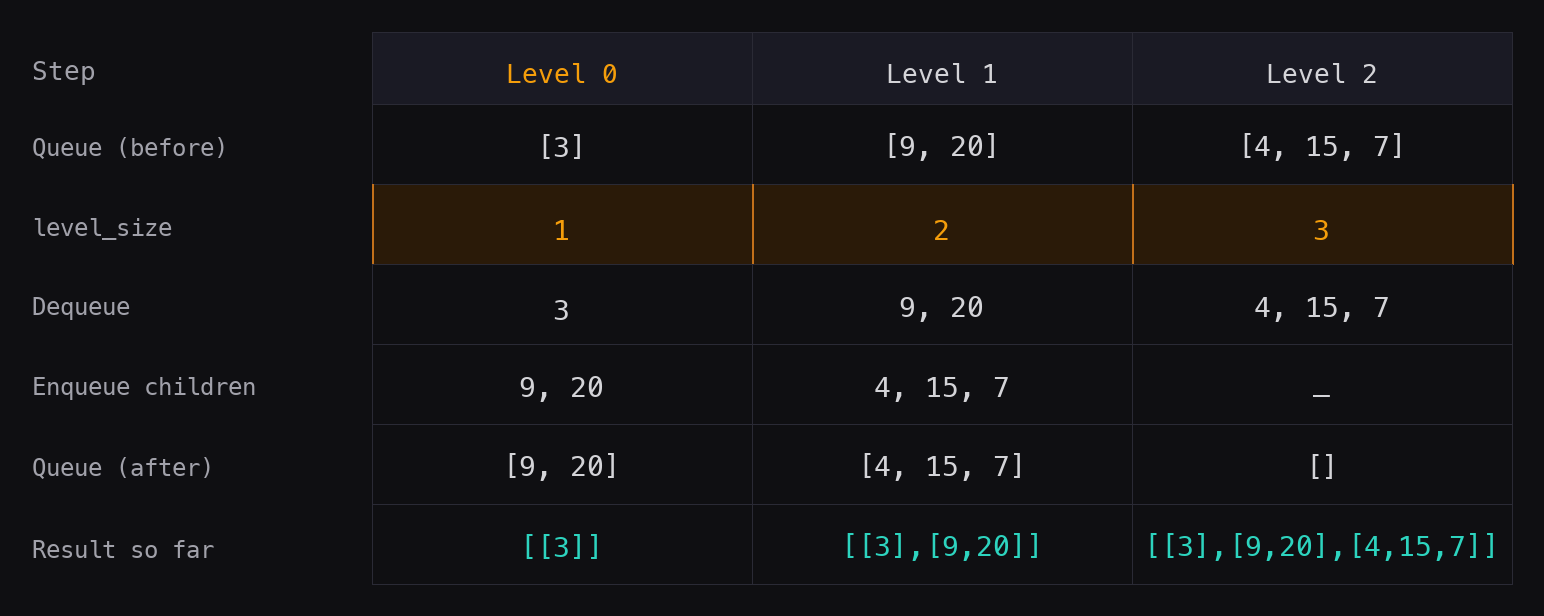
The “aha” moment is recognizing that levels in a tree map naturally to rounds in a queue. Snapshot the queue length at the start of each iteration, and that length tells you exactly how many nodes belong to the current level.
When you put the root into a queue and begin processing, all nodes at the same level are already together in the queue before you start adding their children. Process exactly that many nodes, collect their values, enqueue their children. Repeat.
This transforms “how do I track depth?” into “how many nodes are in the queue right now?”, a much cleaner question.
Here’s the full BFS trace on the example tree, showing the queue contents, the level_size snapshot, and the result building up at each level:
Step 4: Optimal Strategy (BFS with Queue Snapshot)
- Handle the edge case: if
rootisNone, return an empty list immediately. - Initialize a queue (use
collections.dequefor O(1) popleft) containing just the root node. - Initialize a result list to hold each level’s values.
- While the queue is not empty:
- Record the current queue length as
level_size. - Create an empty list
current_level. - Loop exactly
level_sizetimes:- Dequeue a node from the front.
- Append its value to
current_level. - If its left child exists, enqueue it.
- If its right child exists, enqueue it.
- Append
current_leveltoresult.
- Record the current queue length as
- Return
result.
The critical mechanism is step 4’s inner loop: by iterating exactly level_size times, you guarantee that you finish one entire level before the next level’s nodes begin processing.
Python Implementation
from collections import deque
from typing import Optional, List

class TreeNode:
    def __init__(self, val=0, left=None, right=None):
        self.val = val
        self.left = left
        self.right = right

class Solution:
    def levelOrder(self, root: Optional[TreeNode]) -> List[List[int]]:
        if not root:
            return [, "medium"]

        result = [, "medium"]
        queue = deque([root])

        while queue:
            level_size = len(queue)
            current_level = [, "medium"]

            for _ in range(level_size):
                node = queue.popleft()
                current_level.append(node.val)

                if node.left:
                    queue.append(node.left)
                if node.right:
                    queue.append(node.right)

            result.append(current_level)

        return result
The use of deque is intentional. Python lists have O(n) pop(0) operations, making them unsuitable for queues. deque.popleft() is O(1) and keeps the overall complexity tight.
Time Complexity
| Operation | Complexity |
|---|---|
| Visiting every node | O(n) |
| Enqueue / dequeue each node | O(1) per node, O(n) total |
| Building result lists | O(n) total across all levels |
| Overall Time | O(n) |
| Overall Space | O(n), queue holds at most the widest level |
For a perfectly balanced binary tree, the last level contains n/2 nodes, all of which could be in the queue simultaneously. For a skewed tree (like a linked list), the queue never holds more than one node at a time.
Common Interview Mistakes
-
Using
list.pop(0)instead ofdeque.popleft()Python’slist.pop(0)is O(n). On large inputs, this blows up your time complexity from O(n) to O(n²). Always usecollections.deque. -
Forgetting to snapshot
len(queue)before the inner loop If you checklen(queue)inside the loop, or don’t capture it before enqueuing children, you’ll accidentally process the next level’s nodes in the current level’s loop iteration. -
Not handling
root = NoneAccessingroot.valon a null root crashes immediately. A single guard clause at the top fixes this. -
Coding before clarifying the output format Some candidates build a flat list
[3, 9, 20, 4, 15, 7]instead of[[3], [9, 20], [4, 15, 7]]. Confirm the output shape before you start. -
Using recursion and hitting stack limits For a tree with 10^5 nodes in a skewed shape, DFS recursion will hit Python’s default recursion depth limit. BFS with an explicit queue is safer.
-
Starting to code immediately without explaining the approach Interviewers want to follow your reasoning. Walk through your plan verbally before writing any code.
-
Forgetting to check for
Nonechildren before enqueuing Always checkif node.leftbeforequeue.append(node.left). EnqueuingNoneinto the queue will causeNoneTypeerrors in the next iteration.
What a Strong Candidate Sounds Like
“My first instinct here is BFS, since we’re asked to process nodes level by level, a queue is the natural fit. I’ll put the root in the queue, then loop while it’s not empty. The key trick is: at the start of each iteration, I snapshot the current queue length. That tells me exactly how many nodes are at the current level. I process exactly that many, collect their values, and add their children for the next round. I’ll use a
dequefor O(1) pops. Edge case: if root is null, I return an empty list immediately. Time and space are both O(n). This also sets up nicely for zigzag traversal, I’d just reverse alternating levels in the result.”
Example Interview Dialogue
Interviewer: “Given the root of a binary tree, return the level order traversal of its node values.”
Candidate: “Quick clarification: should I return a list of lists, grouped by level? And should I handle a null root by returning an empty list?”
Interviewer: “Yes and yes.”
Candidate: “Great. I’ll use BFS with a queue. At the start of each round, I capture how many nodes are in the queue, that’s my level size. I process exactly that many, collect values, enqueue their children, and append the level’s list to my result.”
[Writes solution]
Interviewer: “What if I wanted the traversal to go right-to-left on alternating levels, like a zigzag?”
Candidate: “Easy extension. I’d keep a boolean flag left_to_right that flips each level. When it’s False, I reverse the current_level list before appending. The BFS logic stays the same, only the append step changes.”
Interviewer: “Nice. What’s your space complexity?”
Candidate: “O(n) in the worst case. A complete binary tree’s last level has about n/2 nodes, all of which could sit in the queue simultaneously.”
Related Problems to Practice
-
Binary Tree Zigzag Level Order Traversal (LeetCode 103). Same BFS structure, but alternate the direction of each level using a flag.
-
Binary Tree Right Side View (LeetCode 199). Use level order BFS, but only keep the last node from each level.
-
Find Largest Value in Each Tree Row (LeetCode 515). BFS level by level, tracking the max value per level instead of all values.
-
Binary Tree Level Order Traversal II (LeetCode 107). Same solution, just reverse the final result list for bottom-up output.
-
Walls and Gates (LeetCode 286). Multi-source BFS on a grid. Structurally very similar to level order on a tree, but applied to 2D problems.
Practice This in a Mock Interview
Reading a walkthrough and solving a problem under interview pressure are very different skills. You won’t have access to notes, and you’ll need to recall the BFS pattern, handle edge cases on the spot, and narrate your thinking clearly.
Start a mock interview for Binary Tree Level Order Traversal on Intervu.
Further reading:
- How to Prepare for a Coding Interview in 2026, the complete roadmap
- Why LeetCode alone isn’t enough, and what to practice instead
- Practice any LeetCode problem as a live mock interview
- The Grind 75 Pathway, a structured study plan with AI practice links
- Browse all walkthroughs on GitHub, condensed solutions with code
- Data Structures for Coding Interviews, including trees and BFS patterns