Minimum Height Trees — Coding Interview Walkthrough
You’re in a coding interview. The interviewer says: “Given a tree with n nodes, find all roots that minimize the height.” You know that brute-force BFS from every node would work, but it’s O(n^2). The efficient approach is less obvious: iteratively trim leaves until 1 or 2 nodes remain. Those remaining nodes are the centers of the tree, the roots of all Minimum Height Trees. LeetCode #310.
This walkthrough covers why leaf trimming works, the connection to the tree’s diameter, and the implementation details that trip up candidates.
The Problem
Given a tree of n nodes labeled 0 to n-1 as an undirected graph (edges), find all nodes that form roots of Minimum Height Trees (MHTs). Trees with those roots have the minimum possible height. There are at most 2 such roots. (LeetCode #310)
Example 1
Input
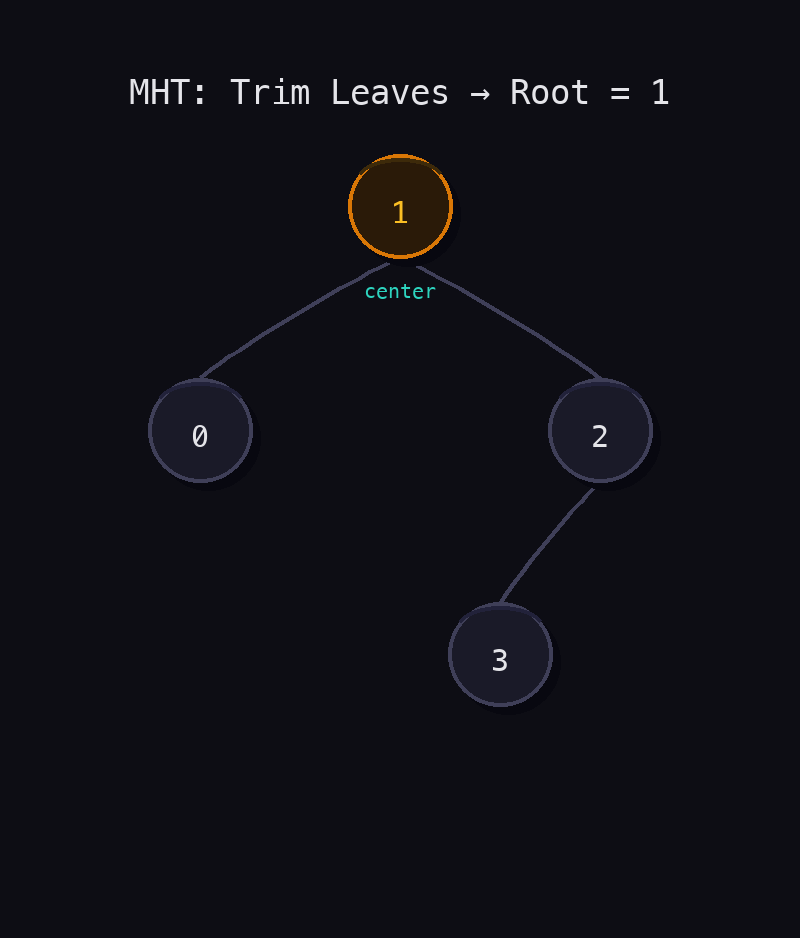
n = 4, edges = [[1,0],[1,2],[1,3]]
Output
[1]
Node 1 is the center. Rooting the tree at node 1 gives height 1. Rooting at any leaf (0, 2, or 3) gives height 2.
Example 2
Input
n = 6, edges = [[3,0],[3,1],[3,2],[3,4],[5,4]]
Output
[3, 4]
Both nodes 3 and 4 are centers. They’re adjacent, each giving a tree of height 2.
Already comfortable with the solution? Practice it in a mock interview →
What Interviewers Are Actually Testing
Minimum Height Trees tests whether you can move beyond brute force and recognize a graph-theoretic property: the optimal roots are always the center(s) of the tree’s longest path.
| Skill | What Interviewers Observe |
|---|---|
| Topological/leaf trimming insight | Do you recognize the iterative leaf-removal approach? |
| At most 2 roots | Do you know there are always at most 2 MHT roots? |
| Degree tracking | Do you use degree counts to identify current leaves? |
| BFS-like layered removal | Do you process all current leaves at once per round? |
| Edge case: n=1 | Do you return [0] for a single node? |
Step 1: Clarifying Questions
-
Is the input guaranteed to be a valid tree? Yes.
n-1edges, no cycles, fully connected. This means every node is reachable. -
Can
nbe 1? Yes. A single node is its own root. Return[0]. -
Can
nbe 2? Yes. Both nodes are leaves and both are MHT roots. Return[0, 1]. -
Are there at most 2 MHT roots? Always. The MHT roots are the center(s) of the tree’s diameter. A path has either one center (odd length) or two (even length).
Step 2: A First (Non-Optimal) Idea
BFS from every node to compute the tree height when rooted at that node. Return the node(s) with the minimum height.
from collections import defaultdict, deque

def findMinHeightTrees_brute(n, edges):
    if n == 1:
        return [0]
    adj = defaultdict(list)
    for u, v in edges:
        adj[u].append(v)
        adj[v].append(u)

    def bfs_height(root):
        visited = {root}
        queue = deque([root])
        height = -1
        while queue:
            height += 1
            for _ in range(len(queue)):
                node = queue.popleft()
                for neighbor in adj[node]:
                    if neighbor not in visited:
                        visited.add(neighbor)
                        queue.append(neighbor)
        return height

    heights = [bfs_height(i) for i in range(n)]
    min_h = min(heights)
return [i for i, h in enumerate(heights) if h == min_h]| Approach | Time | Space |
|---|---|---|
| BFS from every node | O(n^2) | O(n) |
| Leaf trimming | O(n) | O(n) |
Step 3: The Key Insight
The roots of MHTs are the “centers” of the tree, the midpoint(s) of its longest path (diameter). To find them, iteratively trim all current leaves until 1 or 2 nodes remain. Those are the MHT roots. This works because leaves can never be optimal roots: for any leaf, its neighbor is always a better root (strictly lower height).
The algorithm is analogous to topological sort on an undirected tree: peel off the outermost layer (leaves) repeatedly, and what remains is the core.
Step 4: Optimal Strategy
- Build an adjacency set for each node.
- Identify all initial leaves (nodes with degree 1).
- While more than 2 nodes remain:
- Remove all current leaves and their edges.
- Any neighbor whose degree drops to 1 becomes a new leaf.
- Return the remaining 1 or 2 nodes.
Python Implementation
from collections import defaultdict, deque

def findMinHeightTrees(n: int, edges: list[list[int]]) -> list[int]:
    if n == 1:
        return [0]

    adj = defaultdict(set)
    for u, v in edges:
        adj[u].add(v)
        adj[v].add(u)

    # Initialize leaves (degree 1)
    leaves = deque([node for node in range(n) if len(adj[node]) == 1])
    remaining = n

    while remaining > 2:
        remaining -= len(leaves)
        new_leaves = deque()
        for leaf in leaves:
            neighbor = adj[leaf].pop()
            adj[neighbor].discard(leaf)
            if len(adj[neighbor]) == 1:
                new_leaves.append(neighbor)
        leaves = new_leaves

    return list(leaves)
Why this is interview-friendly:
- Set-based adjacency for O(1) removal. Using
setinstead oflistmakesdiscardO(1). With a list, removal is O(degree). remaining > 2as the loop condition. This correctly handles both odd-diameter (1 center) and even-diameter (2 centers) cases.- Each node is processed exactly once as a leaf. The algorithm never revisits nodes.
Time & Space Complexity
| Time | Space | |
|---|---|---|
| Minimum Height Trees | O(n) | O(n) |
Each node is removed as a leaf exactly once. Building the adjacency sets is O(n). Total work is linear.
Common Interview Mistakes
-
Not handling
n == 1. A single node has no edges. The leaf-finding loop produces an empty list. Return[0]explicitly. -
Brute-forcing BFS from every node. Running BFS from each node to measure height is O(n^2). The leaf-trimming approach is O(n). Always mention the brute force first, then explain why it’s too slow.
-
Stopping at
remaining == 1only. Stop whenremaining <= 2. Two nodes can both be MHT roots when they’re equidistant from both ends of the diameter. -
Using a list instead of a set for adjacency. Removal from a list is O(degree), making the overall algorithm O(n * max_degree). Use
set()for O(1) removal. -
Not counting
remainingcorrectly. Decrementremainingby the number of leaves before processing them. If you decrement inside the leaf-processing loop, you’ll stop one round too early or too late.
What a Strong Candidate Sounds Like
“The MHT roots are the center(s) of the tree’s longest path, at most two nodes. I find them by repeatedly trimming leaves: initialize a queue of all degree-1 nodes, remove them and their edges, and collect any new leaves. Repeat until 1 or 2 nodes remain. O(n) time, O(n) space.”
Example Interview Dialogue
Interviewer: Why can a leaf never be an MHT root?
Candidate: Consider any leaf L and its only neighbor P. If we root the tree at L, the height includes the entire subtree hanging off P plus the edge from L to P. If we root at P instead, that subtree height stays the same but we eliminate the extra edge. So P always produces a height at most as high as L, and often strictly lower. This means we can safely discard all leaves.
Interviewer: Why at most 2 centers?
Candidate: The centers are the midpoint(s) of the tree’s diameter (longest path). A path of odd length has one midpoint; a path of even length has two adjacent midpoints. Since a tree has a unique diameter, there are always 1 or 2 centers.
Related Problems
- Course Schedule (LeetCode #207). Topological sort / leaf trimming on a directed graph. Same peeling-layers pattern.
- Number of Islands (LeetCode #200). BFS/DFS on a grid graph.
- Clone Graph (LeetCode #133). Graph traversal and reconstruction.
Practice This in a Mock Interview
Minimum Height Trees is a problem where the brute-force approach (BFS from every node) is obvious but too slow, and the efficient approach (leaf trimming) requires a non-trivial insight about tree structure. Articulating why leaves can never be optimal roots, and why the answer is always 1 or 2 nodes, is what separates a strong answer from a partial one.
Start a mock interview for Minimum Height Trees on Intervu.
Further reading:
- How to Prepare for a Coding Interview in 2026, the complete roadmap and study plans
- Why LeetCode alone isn’t enough, and what to practice instead
- Practice any LeetCode problem as a live mock interview
- The Grind 75 Pathway, a structured study plan with AI practice links
- Browse all walkthroughs on GitHub, condensed solutions with code