Flood Fill — Coding Interview Walkthrough
Flood Fill is the MS Paint bucket tool turned into an algorithm question. It’s the canonical introduction to graph traversal on a 2D grid — the same DFS/BFS pattern you’ll use in Number of Islands, Rotting Oranges, and almost every grid problem. Interviewers use it to check whether you can handle boundaries, avoid infinite loops, and navigate 4-directional movement without overcomplicating the code.
The Problem
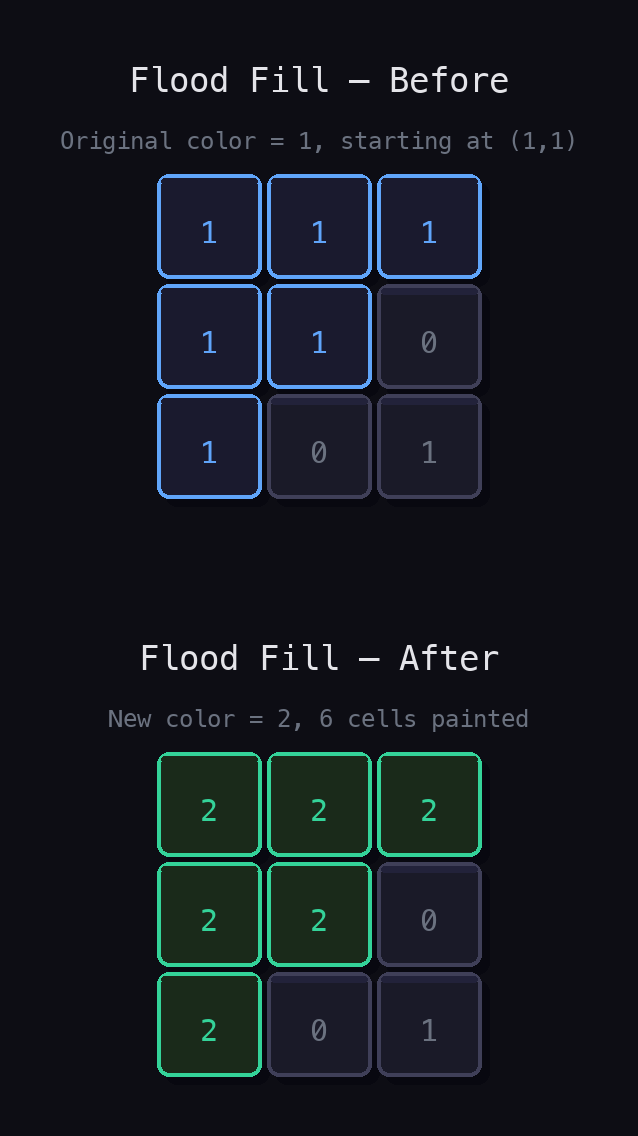
Given a 2D grid image, a starting pixel (sr, sc), and a new color, perform a flood fill starting from (sr, sc). A flood fill changes the color of the starting pixel and all connected pixels of the same original color (4-directional: up, down, left, right).
Example
Input: image = [[1,1,1],[1,1,0],[1,0,1]], sr=1, sc=1, color=2
Output: [[2,2,2],[2,2,0],[2,0,1]]
Already comfortable with the solution? Practice it in a mock interview →
What Interviewers Are Actually Testing
| Skill | What Interviewers Observe |
|---|---|
| Grid DFS/BFS | Can you traverse a 2D grid correctly? |
| Boundary checking | Do you guard against out-of-bounds access? |
| Infinite loop prevention | Do you handle the case where the new color equals the original? |
| 4-directional movement | Do you enumerate all neighbors cleanly? |
Step 1: Clarifying Questions
- 4-directional or 8-directional connectivity? Problem specifies 4-directional (up/down/left/right, not diagonal).
- What if the new color equals the original? Return the image unchanged — otherwise infinite recursion.
- Can the grid be empty? Assume at least 1x1 per constraints.
Step 2: The Key Insight
Flood fill is DFS/BFS from a source cell, painting all reachable same-colored cells. The “visited” mechanism is implicit: once you paint a cell to the new color, it no longer matches the original color, so you won’t revisit it.
Critical edge case: If image[sr][sc] == color already, return immediately — there’s nothing to do, and recursing would cause infinite loops.
Step 3: Optimal Strategy
DFS (recursive):
- Record
original_color = image[sr][sc]. - If
original_color == color: returnimageunchanged. - Define a
dfs(r, c)function: if out of bounds orimage[r][c] != original_color, return. - Paint
image[r][c] = colorand recurse in 4 directions.
Python Implementation
def floodFill(image: list[list[int]], sr: int, sc: int, color: int) -> list[list[int]]:
    original = image[sr][sc]
    if original == color:
        return image  # Avoid infinite loop

    rows, cols = len(image), len(image[0])

    def dfs(r, c):
        if r < 0 or r >= rows or c < 0 or c >= cols:
            return
        if image[r][c] != original:
            return
        image[r][c] = color  # Paint
        dfs(r + 1, c)
        dfs(r - 1, c)
        dfs(r, c + 1)
        dfs(r, c - 1)

    dfs(sr, sc)
    return image
BFS alternative:
from collections import deque

def floodFill(image, sr, sc, color):
    original = image[sr][sc]
    if original == color:
        return image

    rows, cols = len(image), len(image[0])
    queue = deque([(sr, sc)])
    image[sr][sc] = color

    while queue:
        r, c = queue.popleft()
        for dr, dc in [(1,0),(-1,0),(0,1),(0,-1)]:
            nr, nc = r + dr, c + dc
            if 0 <= nr < rows and 0 <= nc < cols and image[nr][nc] == original:
                image[nr][nc] = color
                queue.append((nr, nc))

    return image
Time & Space Complexity
| Aspect | Complexity |
|---|---|
| Time | O(m × n) — each cell visited at most once |
| Space | O(m × n) — recursion stack or queue |
Common Interview Mistakes
-
Not handling
original == color. This causes infinite recursion in DFS or an infinite loop in BFS. It’s the most common bug. -
Checking bounds after accessing
image[r][c]. Always check bounds first to avoid index errors. -
Using 8-directional when 4 is correct. Ask explicitly — the problem says 4-directional.
-
Separate visited set. You don’t need one — the color change itself prevents revisiting. Adding one wastes space.
What a Strong Candidate Sounds Like
“I’ll do DFS from the starting cell. I record the original color, then recursively paint each 4-directional neighbor that has the original color. The early exit on
original == coloris critical — without it, the ‘paint then check’ logic would recurse infinitely. The color change itself acts as a visited marker, so no separate set is needed.”
Example Interview Dialogue
Interviewer: Why do you need the original == color check?
Candidate: Without it, when I paint a cell the new color, the DFS still recurses into neighbors. But since painted cells match the new color — which is the same as the original — they’ll match the original color again and be revisited. This creates infinite recursion.
Interviewer: Could you use BFS instead?
Candidate: Absolutely. The BFS version uses a queue and paints cells as they’re enqueued rather than when they’re dequeued. This prevents adding duplicates. Both are O(m×n) time and space — the choice is whether you prefer a call stack or an explicit queue.
Related Problems to Practice
- Number of Islands — Same grid DFS pattern, counting connected components.
- 01 Matrix — Multi-source BFS on grid.
- Course Schedule — Graph DFS/BFS on adjacency lists instead of grids.
Practice This in a Mock Interview
Flood Fill is a warm-up problem that tests the same grid traversal mechanics used in harder problems. Getting the edge cases right — especially the original == color check — is what separates a clean solution from a buggy one.
Start a mock interview for Flood Fill on Intervu.
Further reading:
- How to Prepare for a Coding Interview in 2026, the complete roadmap
- Why LeetCode alone isn’t enough, and what to practice instead
- Practice any LeetCode problem as a live mock interview
- The Grind 75 Pathway, a structured study plan with AI practice links
- Browse all walkthroughs on GitHub