01 Matrix — Coding Interview Walkthrough

You’re in a coding interview. The interviewer says: “Given a binary matrix, find the distance of the nearest 0 for each cell.” You know this is BFS, and specifically multi-source BFS, seeded from all 0 cells simultaneously. Starting from 1s and searching for 0s (single-source from each 1) would be much slower. This is LeetCode #542, and the distinction between single-source and multi-source BFS is the entire interview signal.
This walkthrough covers how to recognize multi-source BFS, implement it cleanly, and explain the complexity to your interviewer.
The Problem
Given an m x n binary matrix mat, return a matrix where each cell contains the distance to the nearest 0. Distance is measured in number of steps horizontally or vertically. (LeetCode #542)
Example 1
Input
[[0,0,0],
 [0,1,0],
 [0,0,0]]
Output
[[0,0,0],
 [0,1,0],
 [0,0,0]]
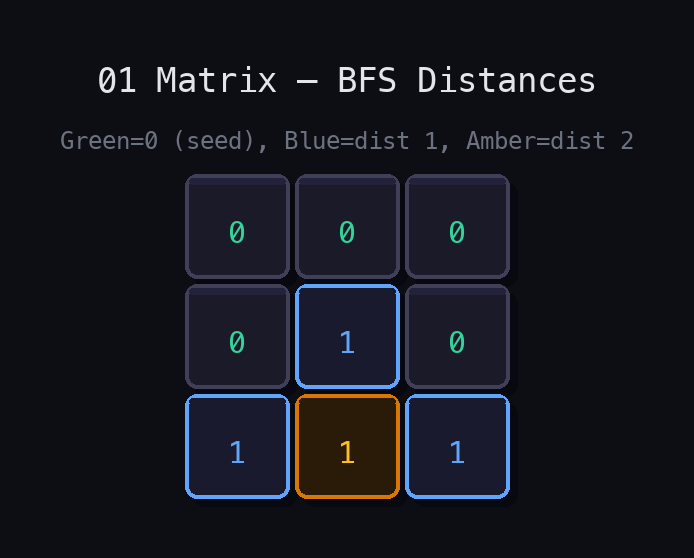
Example 2
Input
[[0,0,0],
 [0,1,0],
 [1,1,1]]
Output
[[0,0,0],
 [0,1,0],
 [1,2,1]]
Already comfortable with the solution? Practice it in a mock interview →
What Interviewers Are Actually Testing
| Skill | What Interviewers Observe |
|---|---|
| Multi-source BFS | Do you seed from all 0s simultaneously, not from each 1 separately? |
| Distance propagation | Do you use BFS levels to propagate distances? |
| Visited tracking | Do you use the output distance matrix itself, initializing 1s to infinity? |
| In-place output | Do you write distances directly into the result matrix? |
Step 1: Clarifying Questions
1. Can the matrix contain only 1s? No, there is guaranteed to be at least one 0.
2. Is distance Manhattan or Euclidean? Manhattan (horizontal or vertical steps only, not diagonal).
Step 2: A First (Non-Optimal) Idea
For each 1-cell, run a separate BFS to find the nearest 0. That works, but it’s O(m * n) per 1-cell, giving O((m * n)^2) total. Far too slow for large grids.
| Approach | Time | Space |
|---|---|---|
| BFS from each 1 | O((m*n)^2) | O(m*n) |
Step 3: The Key Insight
Flip the direction: BFS outward from all 0s simultaneously. Initialize distances of 0-cells to 0 and 1-cells to infinity (or
float('inf')). Enqueue all 0-cells at once. BFS propagates distances outward from all 0s in parallel. The first time BFS reaches a 1-cell, that distance is the shortest, guaranteed by BFS’s level-by-level expansion.
 ---
---
Step 4: Algorithm
- Create a
distmatrix initialized tofloat('inf')for all cells. - Set
dist[r][c] = 0for every cell wheremat[r][c] == 0and enqueue those cells. - BFS: dequeue a cell, check all 4 neighbors. If
dist[neighbor] > dist[current] + 1, update and enqueue. - Return
dist.
Python Implementation
from collections import deque

def updateMatrix(mat: list[list[int]]) -> list[list[int]]:
    rows, cols = len(mat), len(mat[0])
    dist = [[float('inf')] * cols for _ in range(rows)]
    queue = deque()

    # Seed all 0 cells with distance 0
    for r in range(rows):
        for c in range(cols):
            if mat[r][c] == 0:
                dist[r][c] = 0
                queue.append((r, c))

    directions = [(0, 1), (0, -1), (1, 0), (-1, 0)]

    while queue:
        r, c = queue.popleft()
        for dr, dc in directions:
            nr, nc = r + dr, c + dc
            if 0 <= nr < rows and 0 <= nc < cols:
                if dist[nr][nc] > dist[r][c] + 1:
                    dist[nr][nc] = dist[r][c] + 1
                    queue.append((nr, nc))

    return dist
Time and Space Complexity
| Time | Space | |
|---|---|---|
| Multi-source BFS | O(m * n) | O(m * n) |
Every cell is enqueued at most once. The dist matrix serves as both the output and the visited tracker.
Common Interview Mistakes
-
Seeding from 1s instead of 0s. Multi-source BFS from all 1s searching for 0s requires O(n) BFS per 1-cell, totaling O((m*n)^2). Seed from 0s instead.
-
Not initializing 1-cells to infinity. Without a sentinel, you can’t tell which cells have been finalized. Initializing to
float('inf')and updating only when an improvement is found is the clean approach. -
Re-enqueueing cells unnecessarily. The check
if dist[nr][nc] > dist[r][c] + 1prevents redundant enqueuing. If the distance can’t be improved, skip.
What a Strong Candidate Sounds Like
“Multi-source BFS from all 0 cells simultaneously. I initialize the distance matrix to infinity for 1-cells and 0 for 0-cells. BFS expands outward from all 0s in parallel. The first time a 1-cell is reached, that’s its shortest distance. Each cell is processed at most once. O(mn) time and space.”*
Example Interview Dialogue
Interviewer: Why not BFS from each 1 to find its nearest 0?
Candidate: That would be O(mn) per 1-cell, making the total O((mn)^2). Multi-source BFS from all 0s processes every cell exactly once, giving O(m*n) total. The key is that BFS naturally computes shortest paths, so seeding from all 0s at once guarantees each 1-cell gets its shortest distance on first visit.
Related Problems to Practice
- Rotting Oranges (LeetCode #994). Same multi-source BFS pattern with simultaneous spread from multiple sources.
- Walls and Gates (LeetCode #286). Multi-source BFS to fill distances from gates.
- Pacific Atlantic Water Flow (LeetCode #417). Multi-source BFS from two sets of borders.
Practice This in a Mock Interview
01 Matrix is Rotting Oranges with distances instead of times. If you’ve mastered one, the other is a 5-minute adaptation. The core skill is recognizing when to use multi-source BFS.
Start a mock interview for 01 Matrix on Intervu.
Further reading:
- How to Prepare for a Coding Interview in 2026, the complete roadmap and study plans
- Why LeetCode alone isn’t enough, and what to practice instead
- Practice any LeetCode problem as a live mock interview
- The Grind 75 Pathway, a structured study plan with AI practice links
- Browse all walkthroughs on GitHub, condensed solutions with code