Best Coding Interview Prep Tools (2026) — The Developer's Arsenal
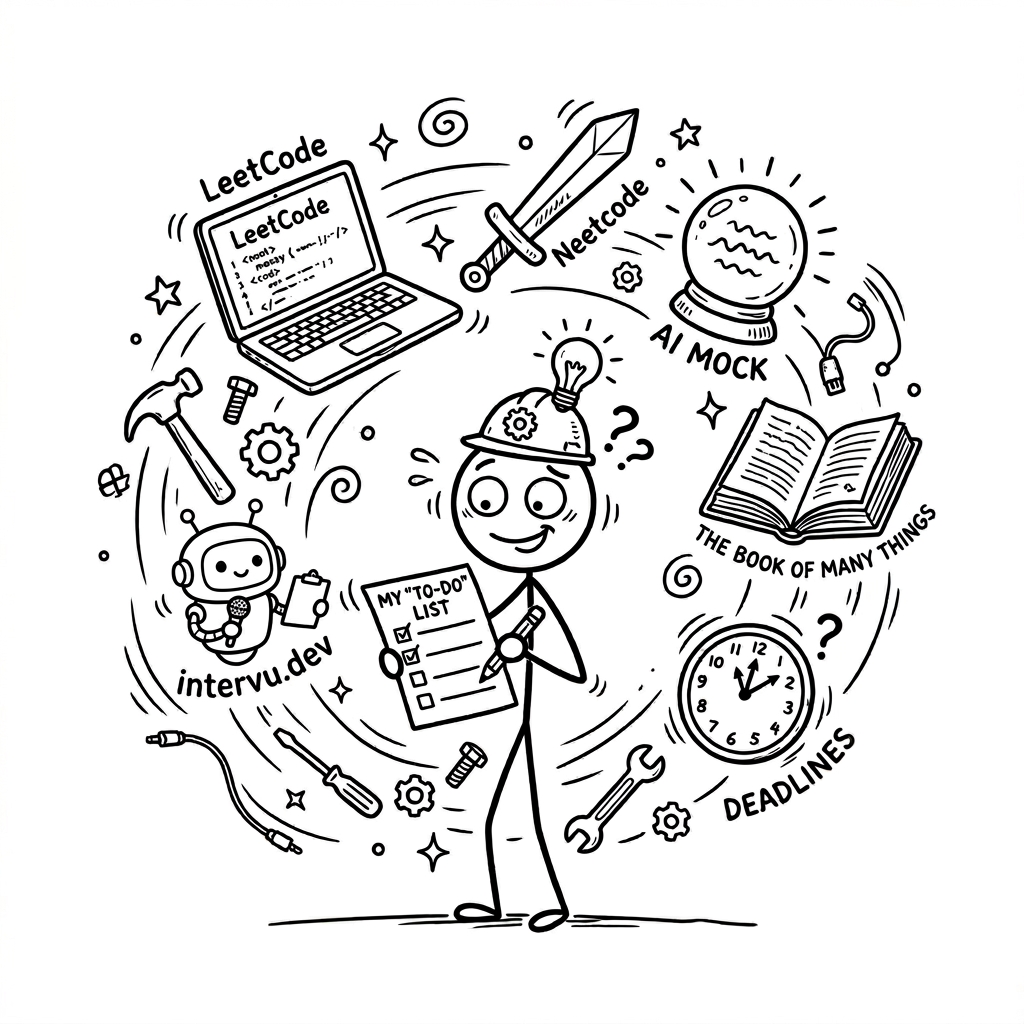
You’ve decided to start preparing for coding interviews — great. You open a browser tab, search “how to prepare,” and immediately land in a maze of Reddit threads, YouTube playlists, and a hundred blog posts each recommending a different roadmap. Twenty tabs later, you’ve learned nothing and your anxiety has tripled.
Let’s fix that.
Coding interview prep has a well-worn path. The tools exist. The question is knowing which tool to reach for at each stage — whether you’re just getting started, drilling your weak spots, or simulating the real pressure of a live interview. This guide walks through every major category with honest takes on what each tool is actually good for.
“The goal of practice is not to rehearse failure. It’s to make the hard things feel ordinary.”
01 — Problem Practice Platforms
Before anything else, you need reps. Thousands of engineers have cracked FAANG interviews by systematically working through problems on the platforms below. These are your primary training grounds.
LeetCode
Tag: Industry Standard
The undisputed default for interview prep. LeetCode’s problem set is enormous — over 3,000 problems — and nearly every technical interview draws from patterns you’ll find here. The company-tagged problems (Google, Meta, Amazon, etc.) are particularly useful for targeting specific employers.
- Structured learning paths by topic (arrays, trees, dynamic programming)
- Weekly contests for timed practice under competitive pressure
- Built-in discussion forums where you can study optimal solutions
- Premium unlocks company-specific question sets and frequency data
HackerRank
Tag: Beginner-Friendly
A gentler entry point than LeetCode. HackerRank’s structured challenges — especially for domains like SQL, regex, and language fundamentals — make it a solid warm-up before moving to harder problem sets. Many companies also use HackerRank to administer their initial screening rounds, so familiarity with the interface helps.
- Certification badges that some employers recognize
- Good for brushing up on SQL and shell scripting alongside DSA
- Competitive ranking system for motivation
Codeforces / AtCoder
Tag: Competitive Programming
If you want to develop speed and sharpness under real time pressure, competitive programming contests on Codeforces and AtCoder are unmatched training. Problems here are often harder than interview questions — which means actual interview problems start feeling manageable. Not essential for everyone, but invaluable for candidates targeting top-tier quantitative or research roles.
02 — Structured Learning Resources
Grinding problems without pattern recognition is the number-one reason candidates plateau. These resources teach you the why behind solutions — which is what separates engineers who can adapt in a live interview from those who can only recall memorized answers.
Neetcode.io
Tag: Free
Built around the famous “Neetcode 150” — a curated list of 150 problems that cover every major interview pattern. The accompanying YouTube explanations are among the clearest on the internet. If you’re pressed for time, this is the highest-return-on-time resource available for free.
- Roadmap organized by topic (two pointers, sliding window, graphs, etc.)
- Detailed video walkthroughs for every problem in the list
- Built-in progress tracker so you can measure consistency
Grokking the Coding Interview
Tag: Pattern-Based
Originally from Educative.io, this course popularized the concept of organizing problems by pattern rather than by topic or difficulty. Once you internalize patterns like sliding window, merge intervals, or fast-and-slow pointers, you can recognize the right approach to a new problem within minutes — even if you’ve never seen it before.
Algorithms by Sedgewick (Princeton Coursera)
Tag: Deep Fundamentals
For candidates who feel shaky on fundamentals — sorting algorithms, graph traversal, balanced BSTs — this free Coursera course is the most rigorous option available. It’s not optimized for interview speed, but the conceptual grounding it provides pays dividends for months afterward.
03 — Mock Interview Platforms
Here’s the uncomfortable truth most guides skip: solving problems alone, in silence, on your own schedule, is fundamentally different from solving them while being watched, on the clock, while thinking out loud. You can be completely competent at one and fall apart at the other. The only fix is deliberate simulation.
Intervu.dev
Tag: AI-Powered Mock Interviews
Intervu’s AI mock coding interview platform is built for exactly this gap. It runs realistic AI-powered mock interviews — complete with follow-up questions, hints calibrated to your progress, and feedback on both correctness and communication. The platform evaluates not just whether your solution works, but how you reason through it, which is what interviewers actually score you on.
What makes it particularly useful is the availability. Unlike scheduling a peer mock, you can spin up a session whenever you have 45 minutes — 11pm before a Friday onsite, or on a Sunday morning with coffee. You can even practice any LeetCode problem as a live mock interview directly on the platform. The AI interviewer doesn’t get tired, doesn’t hold back follow-ups, and gives you consistent, structured feedback after every session.
- Simulates realistic interview pacing with follow-up probing questions
- Feedback on problem-solving approach, not just output correctness
- Available on-demand — no scheduling coordination required
- Useful for candidates who want to practice verbal explanation alongside coding
Pramp
Tag: Peer Mock
Pramp matches you with other candidates for live, peer-to-peer mock interviews. You take turns playing interviewer and interviewee — which is surprisingly instructive on both ends. Watching someone else struggle on a problem you know how to solve clarifies exactly what interviewers are looking for. Completely free, though scheduling can be inconsistent.
Interviewing.io
Tag: Expert Mock
If you want feedback from an actual senior engineer at a top company, Interviewing.io provides anonymous mocks with real industry professionals. It’s the highest-fidelity simulation available — and priced accordingly. Best reserved for the final two or three weeks before an onsite, when you need precise, expert-level signal on your performance.
04 — System Design Resources
Once you clear the early rounds, system design becomes the make-or-break component for mid and senior engineers. Unlike DSA, system design has no single “correct” answer — which makes preparation harder and more nuanced.
System Design Primer (GitHub)
Tag: Free & Comprehensive
Arguably the best free system design resource on the internet. This GitHub repository covers distributed systems concepts — load balancing, caching, database sharding, CAP theorem — with clear diagrams and real-world examples. It’s a reference document, not a course, so use it alongside problem-based practice.
Designing Data-Intensive Applications
Tag: Deep Reading
Martin Kleppmann’s book is the definitive text on how modern distributed systems actually work. It’s dense, long, and worth every page. Engineers who internalize this book speak about system design with a fluency that’s immediately apparent in interviews. Read it over months, not weeks.
Hello Interview / ByteByteGo
Tag: Visual Learners
ByteByteGo (by the author of the System Design Interview book series) publishes visual explainers of complex systems — great for building intuitions quickly. Hello Interview pairs structured walkthroughs with mock practice for system design rounds specifically.
For deeper system design walkthroughs, see our guides on designing a URL shortener and designing a rate limiter.
05 — Behavioral Interview Tools
Technical rounds are the filter. Behavioral rounds determine the offer. A well-structured, specific, and reflective answer to “tell me about a time you disagreed with your team” can be more decisive than any DSA problem. Yet most engineers spend less than 10% of their prep time here.
LinkedIn Interview Prep
Tag: Free
LinkedIn’s built-in interview prep module lets you record video answers to common behavioral questions and get AI feedback on pacing, filler words, and content. It’s basic, but surprisingly useful for identifying the verbal habits you didn’t know you had — like starting every answer with “So, yeah…”
Notion + STAR Template
Tag: Self-Organized
The most underrated behavioral prep tool is a plain Notion doc with a STAR-format story bank. Spend two hours cataloging your most impactful projects, conflicts, and leadership moments. Tag each story with the behavioral themes it covers (ownership, ambiguity, conflict, failure, etc.). When an interviewer asks a question, you pull the right story — not a panicked improvisation.
06 — Quick Comparison
| Tool | Best For | Cost | Beginner-Friendly | Simulation |
|---|---|---|---|---|
| LeetCode | DSA problem volume | Free / $35/mo | Moderate | Low |
| Neetcode.io | Curated pattern learning | Free | High | Low |
| Intervu.dev | AI mock interviews | Freemium | High | Very High |
| Pramp | Peer mock interviews | Free | Moderate | High |
| Interviewing.io | Expert mock feedback | $$ | Low | Very High |
| System Design Primer | Distributed systems concepts | Free | Moderate | Low |
| HackerRank | Beginner + screeners | Free | High | Low |
Putting It Together
The engineers who land offers don’t use every tool. They use the right tools in the right sequence. A reasonable eight-week roadmap looks something like this: spend the first three weeks on fundamentals with Neetcode and LeetCode, building a mental library of patterns. Week four and five, introduce timed sessions and begin tracking where you consistently slow down. Week six onward, shift heavily toward simulation — mock interviews on Intervu for on-demand practice, Pramp for peer rounds, and Interviewing.io for high-fidelity signal in the final stretch. Behavioral prep shouldn’t start at week eight; it should run the entire time in the background.
The most important thing isn’t which platform you choose — it’s building the discipline to show up consistently. Coding interviews reward pattern recognition built through repetition, and communication skills built through deliberate practice. Neither happens in a single cram session.
Start with one tool from each category. Get comfortable. Then stack them.
Ready to Practice Under Real Pressure?
Reading about interview prep is the easy part. The hard part is sitting in front of a problem with a clock running and someone (or something) watching how you think. If you haven’t run a mock interview yet, start there.
Start a free AI-powered mock coding interview on Intervu — no scheduling, no judgment, just structured practice and actionable feedback on your problem-solving process. It’s free to start.
Further reading:
- How to Prepare for a Coding Interview in 2026, the complete roadmap with study plans
- Why LeetCode Alone Isn’t Enough, what to practice instead
- FAANG Coding Interview Guide, company-by-company breakdown
- Practice Any LeetCode Problem, as a live mock interview
- The Grind 75 Practice Pathway, a curated problem list
- How to Use Intervu with Grind 169, 10-week plan for the expanded 169-problem list